

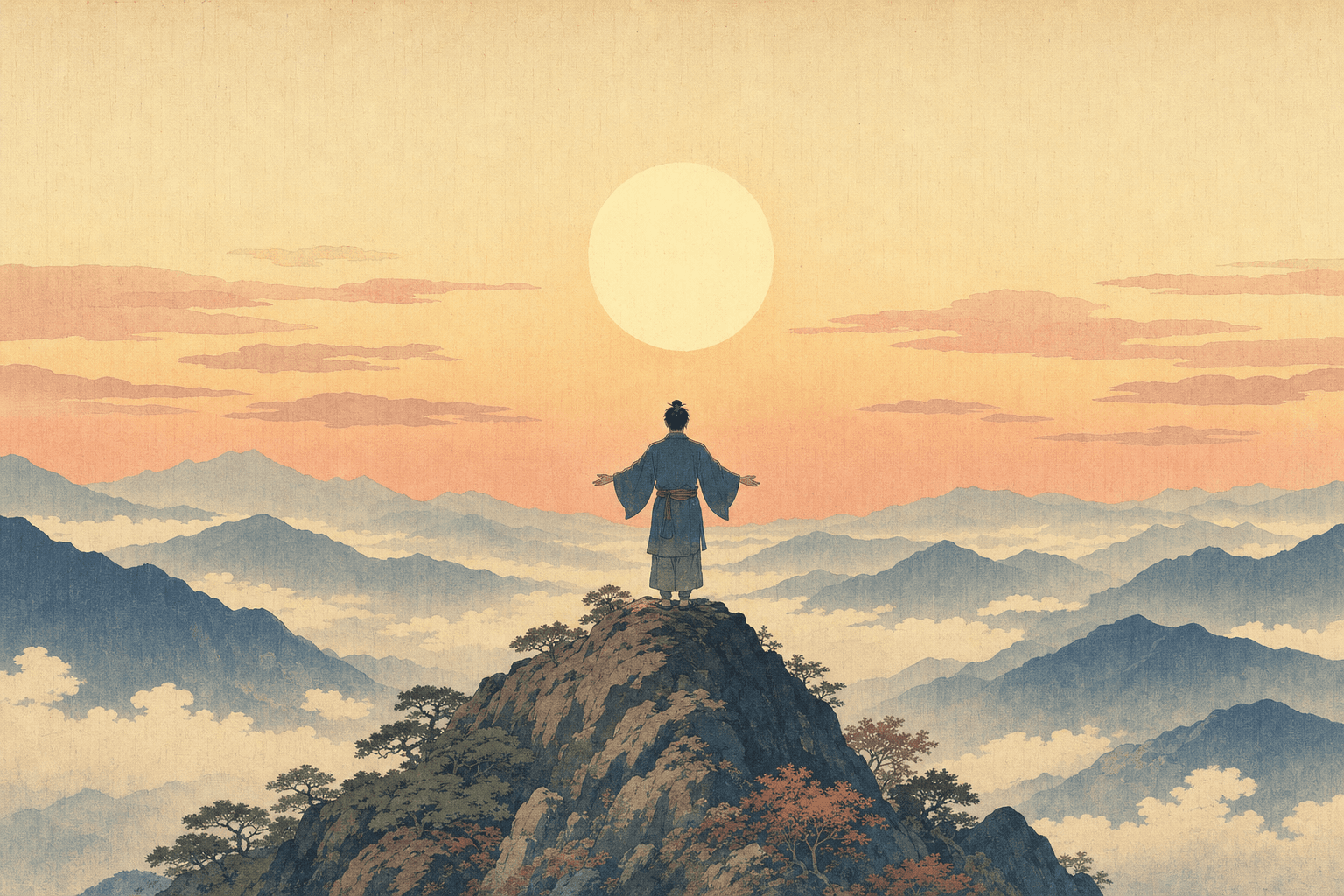
The Audacity to Live
Episode 225 of the Secular Buddhism Podcast
Hello and welcome to another episode of the Secular Buddhism Podcast. This is episode number 225. I am your host, Noah Rasheta, and today I want to talk about death. And more specifically, I want to talk about what death has to teach us about being alive. I'm calling this episode "The Audacity to Live," and by the end, I think you'll see why.
Why Some Deaths Hit Differently
About a week ago, one of the greatest mountaineers of our time, Nirmal Purja, the world knew him as Nims, died in an avalanche on a mountain in Pakistan, along with nine other climbers. I first learned about Nims back in 2021, watching his documentary on Netflix called 14 Peaks. He set out to climb all fourteen of the world's 8,000 meter peaks in seven months, something the experts considered impossible, and he did it in six.
And I remember watching and being immediately struck by his ability and his audacity to attempt what looked like, to me, superhuman feats. A few years ago, I was on a trek to Everest Base Camp, and near the village of Namche Bazaar, I watched his skydiving team land from a jump at an altitude where it seemed crazy for anyone to be skydiving at all. And then after that trek, I visited his store in Kathmandu. He was someone I looked up to, truly a once-in-a-generation kind of human.
Now, here's what I've been noticing since the news broke. Some deaths just hit differently. I remember when Steve Irwin died, the Crocodile Hunter, and people all over the world who had never met him grieved like they had lost a friend. And I'm watching a similar thing happen right now with Nims, and I've been asking myself, "Why is that? Why do these particular deaths hit so hard?"
Well, I think it's because these were people who were so obviously so fully alive that watching them felt like watching what a human life could be. They were deeply passionate about what they did and how they lived. And when someone like that dies, I think a part of what we're feeling isn't just grief for them, it's a quiet, uncomfortable question about us. Am I living my life that fully?
And that's the question I want to sit with today. As always, keep in mind you don't need to use what you learn from Buddhism to become a Buddhist. You can use what you learn to simply be a better whatever you already are.
And with that in mind, I want to spend some time exploring what I can only call the audacity to live. What is the difference between going through life simply being alive and living audaciously? And what does Buddhism, specifically the Buddhist relationship with death, have to teach us about that difference?
We Are the Lucky Ones
I want to start somewhere that might surprise you, not with a Buddhist teacher, but with a biologist. Richard Dawkins opens his book Unweaving the Rainbow with a passage I've never forgotten, and I want to read you the whole thing because I think it deserves to be heard in full. He says, quote:
"We are going to die, and that makes us the lucky ones. Most people are never going to die because they are never going to be born. The potential people who could have been here in my place, but who will in fact never see the light of day, outnumber the sand grains of Arabia. Certainly, those unborn ghosts include greater poets than Keats, scientists greater than Newton. We know this because the set of possible people allowed by our DNA so massively exceeds the set of actual people. In the teeth of these stupefying odds, it is you and I in our ordinariness that are here. We privileged few who won the lottery of birth against all odds. How dare we whine at our inevitable return to that prior state from which the vast majority have never stirred?"
Close quote. I love that passage. Think about that for a minute. The potential people who were never born, who will never see a single day of life, outnumber the grains of sand. And yet, here we are, you and me, and we are going to die. And that actually makes us the lucky ones because it means we got to be here at all.
And when I sit with that, something shifts in how I see my own life, because we spend so much of our time feeling like our lives are ordinary, right? Ordinary job, an ordinary weekday, an ordinary sink full of dishes. But against those odds, the fact that there's anyone standing at that sink at all is staggering.
There is nothing ordinary about an ordinary life. And I'm going to repeat that because it's the kind of message that's at the heart of this whole episode. There is nothing ordinary about an ordinary life. The fact that we get to be alive at all might be the most extraordinary thing that will ever happen to any of us.
The Ticket in the Drawer
So here's the thing. If being alive is the winning lottery ticket, why do so many of us live like the ticket is still sitting in a drawer somewhere? We won, and we know we won, and yet we keep waiting for a better time to cash it in. After the busy season at work, or after the kids are older, after things settle down.
Why do we do that? I think the Buddhist answer, and it's an answer that Buddhism has been giving for over 2,500 years, is this: because we've stopped looking at death.
I often say that if you don't think about death often, you can't truly live. And I know how that sounds. It might sound dark, it might sound morbid. It sounds like the opposite of an inspiring message. But stay with me, because I think this idea is the doorway to everything else in this episode.
Of all the mysterious and odd things that we do as humans, avoiding the thought of death might be the most fascinating one to me. Because we know it's coming. We don't know when, we don't know how, and yet we go about our days as if ignoring it long enough might keep it from ever finding us. And the price we pay for that thinking is that we don't truly live.
One Mouthful, One Breath
Now, the Buddha had a lot to say about this, and there's one teaching in particular that I want to share, and it comes from early Buddhist texts, and it goes like this.
The Buddha asks a group of monks how they practice mindfulness of death, and the first monk says, "Well, I reflect that I might just have one day and one night left to live, so I practice accordingly." And the Buddha listens, and a second monk says, "I reflect that I might just have this day." Another one says, "Just the time that it takes to eat a single meal." And another one, "Just the time it takes to swallow four mouthfuls of food." And another, "Just one mouthful." And finally, a monk says, "I reflect that I might just have time to take one breath in and one breath out."
And here's the part that gets me. The Buddha says that the monks thinking in terms of a day, even the ones thinking in terms of a single meal, are still living heedlessly. They're still asleep. Only the last two, the monk at one mouthful and the monk at one breath, does he describe as truly awake.
Think about what he's saying there. Death isn't a someday problem. The honest timescale, the true timescale, is this breath, this one.
And you know, it occurred to me while I was preparing this episode that a mountaineer above 8,000 meters lives at exactly that timescale. Up in what climbers literally call the death zone, you don't get to think in years or in seasons. You get this breath, and then this next breath. And maybe that's not a coincidence. Maybe that's part of why someone like Nims seemed so intensely alive to the rest of us. He spent his life at the timescale the Buddha said is the truthful one.
The Five Remembrances
And now, the Buddha didn't just leave us with a story, he gave us a practice, something he recommended for everyone, monks and ordinary people alike, and this practice is called the five remembrances. And if you're a listener of the podcast, you might remember I've talked about these before, but they kind of hit differently for me this week.
In plain language, they go like this. The first one is, "I will age. I haven't gone beyond aging." And then, "I will get sick. I haven't gone beyond sickness. I will die. I haven't gone beyond death. Everything and everyone I love will change, and one way or another, I will be separated from them." And the fifth one is, "My actions are the only things I truly own."
And here's the framing that I think matters most. The Buddha said the reason we need these reflections is that we walk around as if we were intoxicated, and that's his word. That's the word that's used, intoxicated. Intoxicated with our youth, intoxicated with our health, intoxicated with being alive, in the sense that we're so drunk on the assumption that it will continue that we live carelessly. And the five remembrances aren't the antidote to joy, they are the antidote to the intoxication.
Samvega and Pasada
And there are actually two words in the ancient Pali language that I think describe exactly what many of us have been feeling this week, and we don't really have good English equivalents for either of them.
The first is samvega. Samvega is the jolt. It's that jolt of urgency that hits when mortality suddenly gets real, when the fact of death stops being an idea and becomes a fact. It's what the young Siddhartha felt before he became the Buddha when he left the palace and saw an old man, a sick man, and a corpse for the first time.
And the second word is pasada. Pasada is what keeps samvega from collapsing into despair. It's kind of a settled, calm confidence that there is a way to respond, that the jolt can become a path instead of panic.
And what I felt when I heard the news about Nims was a little bit of that samvega. And this episode, I think, is my attempt at creating some of that pasada.
The Bardo: We Are Dying All Day Long
I want to tell you a story about the first time I really recognized death, the first time it got my attention. This is many years ago. One of my closest friends was dying of cancer, and while he was sick, he recommended a book to me, a book that he had encountered called The Tibetan Book of the Dead. So I started reading it, and by the time I finished it, he had already passed.
Long-time listeners might remember I explored some of the ideas of this book back in episode 198, but I want to share the part of the book that has stayed with me all these years because I think it belongs at the center of this episode.
The Tibetan Book of the Dead is built around this concept of the bardo, and the word bardo simply means in between, a transitional state or a gap. And traditionally, it refers to the state between death and rebirth. But here's what surprised me. Chögyam Trungpa, one of the teachers who first translated that book for the West, used to say it should almost be called The Tibetan Book of Birth, because its real subject isn't the afterlife at all. Its real subject is that birth and death are happening in every single moment.
Every moment is a bardo, a gap between what just ended and what hasn't started yet. Something is always ending. Something is always beginning. We are dying and being born all day long, and we almost never notice.
And there's a Tibetan teacher named Anam Thubten who describes this in a way I really like. He talks about running a simple errand with a friend. You go out to buy art supplies, and he describes that errand as a complete lifetime. It's born the moment the two set out. It lives for a little bit of time, and when the errand is done and the two friends part ways, that lifetime ends. And that's it. A whole life with a birth and a death inside one ordinary afternoon.
And you can take that idea with you everywhere. The episode you're listening to right now, this is a lifetime. It started the moment you hit play, and this lifetime will end the moment the episode ends. Your commute this morning was a lifetime. The conversation you had with your kid at breakfast, that was a lifetime, and it's already gone, and a new one has already started.
You see, the idea here is that when we get familiar with the small deaths, the endings that happen all day, every day, something happens to our fear of the big one. It starts to loosen because it turns out we've been dying all along, moment by moment by moment, and we've survived every single one of those deaths so far.
And it's the background fear of the big death, the one we refuse to look at, that keeps us living small. It keeps us postponing. It keeps that lottery ticket in the drawer.
The way I think about it now is this: the book I read to understand my friend's death ended up teaching me about my own life. That's what the wisdom of death does. You go looking for answers about dying, and what you find are instructions for living.
Audacity Isn't About Risk, It's About Honesty
So death awareness is the doorway, but what's on the other side of it? What does audacious living actually look like? And I want to be careful here because I think there's a misconception worth clearing up. The audacity to live does not mean climbing mountains. It doesn't mean skydiving. It doesn't mean quitting your job and moving to Nepal. Those might be someone's version of it, but I don't think that audacity is about risk at all. I think it's about honesty.
So let me tell you what I mean. There's an author named Bronnie Ware, who worked for years in palliative care, sitting with people in the last weeks of their lives, and she started recording the regrets she heard, and eventually wrote a book about the five that she heard the most often.
And number one, the single most common regret of the dying, in her words, was this, quote: "I wish I had had the courage to live a life true to myself, not the life others expected of me." Close quote.
Notice the word courage in there. The dying, in her experience, didn't regret the risks they took. They regretted timidity. Nobody at the end of their life wished they had played it safer. They wished they had been more honest about who they were and had lived accordingly.
And that brings me back to Nims. He has a quote that I really like. He said, quote: "I climb so I can live every moment of my life." Close quote. And I love that because notice he's not saying, "I climb to conquer mountains," or, "I climb to set records." The climbing was in service of something, and the something was being fully alive. He found the thing that made him feel alive, and then he went and did it, with enthusiasm and joy.
He also used to say, quote: "You only got one life, live it." Close quote. I don't think he was ignoring death. I think he was living with death in full view, and he chose the mountains anyway.
Choosing What Feels Right
Now, here's the vulnerable part for me, because at several junctions in my own life, I've had to choose between what felt right and what felt easy. And I've noticed that sometimes following the path that feels genuine and authentic is going to disappoint people. And it's not because they're bad people, but because they don't understand why we do what we do, and they don't have to. I've felt that tension at multiple points in my life in pursuit of what made sense to me.
And I'd love to tell you that that choice gets easier with practice, but I'm not sure it does. But I can tell you this: I've never once regretted choosing what felt right in my heart.
And I think this is where the word audacity earns its place, because living honestly takes a certain amount of nerve, doesn't it? It takes audacity to live your life in a way that feels true to you when the people around you are quietly voting for a version of you that's more convenient for them. It doesn't have to make sense to anyone else. If the way you're living feels genuine, it feels authentic, and it feels like you're actually alive in your own life, at the end of the day, that's what matters.
Maybe that's all that matters, because every single one of us is heading toward the same ending. None of us are getting out of this experience alive.
What's Your Thing?
Now, I've mentioned my thing. I seek adventure so I can live every moment of my life, and for me, that is flying. I fly as a paraglider pilot, and when my feet leave the ground, I am fully, completely there.
But flying is just my thing. And honestly, it's not just flying. It's not just the big things. I smile, I laugh, I cry. I let myself feel all of it, so I can live every moment of my life.
The poet Mary Oliver has a line that asks this question better than I ever could. She says, quote: "Tell me, what is it you plan to do with your one wild and precious life?" Close quote.
So let me turn that toward you. What's your thing? What do you do so you can live every moment of your life? And if you haven't found it yet, if you haven't yet found the audacity to live, well, if not now, when?
The Question Underneath the Question
And there's one more layer to this that I want to explore, and for me, I think it's the deepest one.
When someone like Nims dies, everyone talks about the records. Fourteen peaks, six months, the photographs from the summits. But I've noticed something about the tributes that people are sharing. The ones that move me the most aren't about records at all. They're about how he made people feel. And that raises the question that these moments always raise, the question underneath the question. When our moment comes, what do we actually leave behind?
I recently came across a poet on Instagram whose work has resonated deeply with me. Her name is Gemma Arnold, and she has a poem about exactly this question, and I want to read it to you. She writes, quote:
"In a church one day, maybe, I will lay, surrounded hopefully by the ones who loved me. And I'd want to ask them, 'So what was it? What was my legacy? What is the mark I will leave? The parts of me you will miss the most as you grieve? Please don't say it was my face, now waxen and void of expression, unobserving and of no consequence in this final resting place, nor my body or the clothes I chose, which not only made me happy, but let the world see me how I wanted to be seen. Now this shroud is my only adornment, and the style I refined all those years, as though it were important, lies dormant.
Don't let it be the grades I achieved, or didn't, more likely, or the work I did, and the customers I always spoke to politely. Please don't let that be all you remember of me, nor how clean my house or what car I drove, the movies I watched or the books I read.
No. When I go, please tell me what you'll remember the most is how I loved, how I always strove to see the one in front, how I got on my knees to speak to children and those too sick to stand, how I offered my heart and hands whenever I saw need, and greed repulsed me. When you weep at my grave, I want it to be because you remembered how I believed that the world could be saved with simple acts of kindness, how I believed presence is what defines us. I hope my loved ones will still hear my words of encouragement and how I always, always told them I loved them.'
And as I haunt these rooms and trace the fingerprints I left behind, I hope that I find a life lived well, that the mark I left on the world was big enough to carry my memory through the remaining days of every life I touched. And for me, perhaps, that will simply be enough. In fact, it will simply be enough."
Close quote. If her style resonates with you the way it does with me, you can find her on Instagram. Her handle is whatgemwrot. That's whatgemwrot, all one word. And she has several poems that have landed deeply for me, and this is just one of them.
There's a line in there that undoes me a little every time. "Please don't say it was my face. Don't let it be the grades, the work, the house, the car. Please tell me that you'll remember the most is how I loved." And this one, "presence is what defines us."
Leaving People Better Than I Found Them
So I've been sitting with this question of legacy in my own practice lately, and I want to share where I've landed, at least for now.
I used to think about legacy the way most of us are taught to. You know, what will I build? What will I accomplish? What will have my name on it? And here's where I've come out. I don't just want to leave the world better than I found it. I want to leave people better than I found them.
And let me say what I mean by that. I want my interactions with people, my friendships, my words, the work that I do, to leave people feeling a little more seen, a little more understood, a little more at home in themselves. Not improved, not fixed, just better for having been in the room with me. I want to inspire people to be a better whatever they already are.
And I think the deepest version of this is something that I've come to understand slowly over years of paying attention. I've read the idea somewhere that what people want more than almost anything is just to be seen, to be understood, and to feel validated. To know that someone witnessed their human experience without any intent of changing them.
Think about that for a minute. I think we can all sense it, can't we? Even to a small degree, when someone wants us to be different than how we are, we pick it up instantly. A slight agenda in the conversation, or a quiet disappointment behind the encouragement. And we all know the opposite feeling too, the rare feeling of being around someone who accepts us completely.
And I want to be clear that accepting isn't the same as agreeing. These are people who might see things totally differently than we do, but they allow us to be fully who and how we are, and they love us either way. That is nurturing, and that is rare.
And I have a few friends like that in my life. These are friends where I know that no matter what I believe or don't believe, no matter how I live my life or what choices I make, they will be there. And those are the deepest, most meaningful connections I have.
And here's what I've realized. That's the kind of person I want to be. That's the legacy I'm actually interested in. And maybe when it's all said and done, that's the most audacious thing on this whole list, more audacious than any mountain: to simply let people in your life be exactly who they are, and to love them there.
The Invitation
So let's circle back to where we started. Why do deaths like this one hit so hard? I think it's because they remind us that the ticket is still in the drawer. We haven't cashed it in, that we've been postponing, waiting for a better time to live our own lives fully. But here's the good news hiding inside that discomfort. You're still holding the ticket.
So I want to leave you with an invitation this week, and it's a small one. In Bhutan, there's a piece of folk wisdom that says, "If you want to be a happy person, you should contemplate death five times a day." Five times a day. And what's fascinating to me is that the research kind of backs this up. There's a study where researchers had one group of people contemplate death and another group contemplate something merely unpleasant, and the death group's minds automatically drifted toward gratitude, toward thoughts of joy. Reflecting on death, it turns out, doesn't make us morbid, it makes us grateful.
So here's the invitation. Once a day this week, just pause and remember, "I will die, and I don't know when." And that's it. That's the whole practice. And then notice, what does that thought do to the next ten minutes of your life, or to the rest of your day? Notice how you look at the people in the room with you. Notice what suddenly matters and what suddenly doesn't.
Do Not Squander Your Life
And I'll leave you with one last image. In Zen monasteries, there's a wooden board called a han, and it hangs outside the meditation hall, and it's struck with a mallet to call people to practice. And over the years, the mallet slowly wears the wood away, which I find beautiful because that reminder is itself impermanent.
But carved into that board is a verse, and it usually goes something like this, quote:
"Let me respectfully remind you, life and death are of supreme importance. Time swiftly passes by, and opportunity is lost. Each of us should strive to awaken. Take heed. This night, your days are diminished by one. Do not squander your life."
Close quote. This night, your days are diminished by one. Do not squander your life.
Being alive might be the most extraordinary thing that will ever happen to any of us. May we each have the audacity to live.
As always, keep in mind you don't need to use any of this with the goal of becoming Buddhist. You can use what you learn to be a better parent, a better friend, a better partner, or simply a more mindful human being, living this one wild and precious life you've got.
If this episode resonated with you, feel free to share it with someone who might need it. As always, thank you for listening. Thank you for being a part of this journey with me. And until next time.