

Secular Buddhism Podcast
Episode 224: Twelve Lessons from The Odyssey
Hello, and welcome to another episode of the Secular Buddhism Podcast. This is episode number 224. I'm your host, Noah Rasheta, and today I'm going to talk about some of the lessons I think we can learn from The Odyssey. Keep in mind, you don't need to use what you learn from Buddhism to be a Buddhist. You can use what you learn to simply be a better whatever you already are.
Why The Odyssey?
All right. You're probably thinking, "Why are we talking about The Odyssey?" Well, last night I saw the new movie, The Odyssey, by Christopher Nolan, and I really liked it. I had studied The Odyssey in school many years ago, like probably a lot of us did, and I hadn't really thought about it since, but I loved the movie.
Before going to the movie, I revisited the storyline, and then after the movie, I did a deep dive again into the original story. As I revisited these stories, I kept having this experience where I would think to myself, "Wow, this correlates really well with the teaching of the second arrow," or, "This correlates with the parable of the raft," or, "This is a beautiful way to represent the concept of no self," et cetera.
Because here you have this story that's almost 3,000 years old, written centuries before the Buddha was even born, and it describes the very ideas that I've spent the last 10 years exploring on the podcast through a Buddhist lens. I think it's worth reflecting on these stories, because these ancient stories, these epic stories, are not just Greek stories, they're not just Stoic lessons. These are human lessons. These are the stories of humanity, the stories that are passed down across generations to teach ideas, to pass along a lesson of some sort, very much like Aesop's Fables and the Tortoise and the Hare, or something along those lines. I think these are very human lessons, very powerful lessons, and I want to talk about them through the Buddhist lens, through the Buddhist perspective.
And again, just like with the Tortoise and the Hare or any story that I share on here, it doesn't matter if this really happened or not. The point of the story is: what is the teaching that we can extract from it?
The Odyssey is a poem originally written by Homer. It's a classic, it's long, and it's been translated and interpreted in different ways. Off of these translations, they've made films, including this most recent one by Christopher Nolan. It's a great film. I really enjoyed it.
If you are afraid of spoilers, I'm going to talk about the story itself, not necessarily the film. But the film, as all films tend to do, took creative liberty to condense some of the story and blend things to make it work and fit within the timeframe of a movie. So I would say if you're afraid of spoilers, go watch it first, then come back. If you're the kind of person who's like, "I wanna know all the details, it'll make me appreciate the movie even more," then listen to this and then go watch the movie. And again, I'm presenting the lessons and the stories from the poem version rather than from the movie, and yet there are aspects of the movie that presented things in a perspective that I really liked, and I'll share those as well.
Haunted by His Own Greatest Victory
One of the things I have not been able to stop thinking about since watching the movie is the overall theme that I see in the movie, and it's the theme I want to run through this whole episode: the movie presents Odysseus as a man who's haunted by his own greatest victory.
If you recall the story of Odysseus and the story of Troy, Odysseus is the person who came up with the idea of leaving the horse, the Trojan horse, the famous Trojan horse. The giant statue of a horse, and the soldiers were hidden inside, and that was the trick that ended a 10-year war. They had been there fighting for 10 years. They were not making progress, and Odysseus has this idea and says, "Let's make it look like we're done and we're leaving, and we'll leave behind a gift." And the gift is a giant statue of a horse.
It was probably the most clever thing that he ever did, and it worked. The Trojans bring the horse into the city, and then at night the soldiers sneak out of the horse and go open the gate, and that's how they're finally able to enter the city of Troy and conquer it.
So that victory also becomes his wound. It's his wound because he realizes the tremendous cost of his trickery, that his grand idea came at the cost of what happened to the people inside the city once the gates were open.
You watch the film depict his journey spending 10 years trying to get home, and you realize the reason he can't get home has less to do with the obstacles he's encountering or the sea itself. It has more to do with what he's carrying. Because the thing is, the past can't be undone. It can only be carried.
I think all of us know something about that. Maybe it's not war, but it's a decision that was made, and it was made in a way that made complete sense at the time, and that decision set something in motion, and we've had to live with what was set in motion ever since. And that's how it works. The past is fixed. We don't get to change it. We don't get to go back. But our relationship to the past is not fixed. That can change. And that's really the whole point of this episode.
So I wanna walk through 12 lessons from The Odyssey in the order that they happen on the voyage. If you never read it, all you really need to know about the overall story is this: it's a story of a man who leaves home to fight in a long war. The war finally ends, and it takes him 10 years to get back home because everything in the world and everything inside himself is getting in the way.
One thing I find kind of fascinating is that Homer starts the story in the middle of the mess, not at the beginning. And that's exactly how life works for us when we encounter Buddhist practice, right? We wake up mid-voyage. We're living a life mid-voyage, already blown off course, and now we're like, "Okay, well now what do I do?" That's usually when we encounter teachings, teachings like Buddhism, or teachings like the lessons that we can extract from the story of The Odyssey. So the same way that Homer starts the story in the middle, we're gonna start there too.
Lesson One: The Lotus Eaters and the Danger of Comfort
Early in the journey, the crew trying to make their way home lands on an island where people eat a flower called the lotus. The people there are gentle. They don't attack anyone. They just offer sailors that special fruit. And the sailors who eat it, it removes all the pain of the war, all of their feelings of being homesick, all of that fades. But along with it, something else fades. They lose all desire to go home.
Odysseus has to physically drag his men back to the ships while they're weeping and crying. They don't wanna leave. That's the effect of the lotus.
Here's what I find fascinating about this. Of all the dangers in this overall story, and there are many, there are monsters and storms and giants, the first danger here is the danger of comfort. The lotus doesn't hurt anyone, and that's the trap. It just quietly dissolves their memories and their longing for things that actually matter.
I think we all have our own version of the lotus. It can be our phone. It can be social media, scrolling through an entire evening. For some, it could be the drink or the second drink, or the bottle, as they say. It could be staying busy, staying so busy that we never have to feel anything, because how can I feel anything? I'm busy all the time.
None of these things directly attack us. They just soften everything. And I think life can suddenly go by like that. The thing is that numbing is not peace. I've said before, meditation, for example, as a tool, is not about feeling good. It's about being good at feeling. So the pain of the war and the longing for home are somewhat the same sensitivity, and you can't numb one without numbing the other.
The lesson in that part of the story is you've gotta face the thing that you're actually facing. It's not going to be helpful to try to numb it.
Lesson Two: The Cyclops and the Cost of Being Somebody
Next on their journey, they land on the island of the Cyclops, the one-eyed giant. This might be my favorite lesson from the entire story, and it's not depicted in the movie.
Odysseus and his men get trapped in the giant's cave. All of that is in the movie, but the details that I'm about to share are not in the movie. The giant is eating the humans, eating the crew, and it eats them two at a time, then it falls asleep. So while it's asleep, that's how Odysseus comes up with a trick to try to escape. The giant asks him his name, and he says, "My name is Nobody, and that's what everyone calls me."
Then through the story, again, in the poem version, they get the giant drunk and then blind him by taking a sharpened stake and stabbing his eye. So the giant screams for help, and there are other giants that come running, and they're asking, "Who's hurting you?" And the giant yells back, "Nobody. Nobody is hurting me." So then the other giants shrug, and they go home, and that's how Odysseus and his men escape. It's a trick that worked pretty well.
Once they're on the ship and they're sailing away, this is the part that I think is so interesting and correlates well with Buddhism. Here, Odysseus can't help himself. He stands on the deck and he shouts back at the island, "If anyone asks who blinded you, tell them it was Odysseus, the sacker of cities."
And again, this is in the poem version. It's not in the movie. So he gives his name. He gives his title. And the giant turns out to be a son of Poseidon, and Poseidon, god of the sea, decides, "Well, I'm gonna take my revenge. You hurt my son, so I'm not gonna let you get home." That's actually what sets the whole dilemma on the sea, encountering storms. Ultimately that one moment of bragging, of trying to take claim of who is it that did this, it costs him 10 years to get home.
If you think about this for a minute, this is the part I liked. Being nobody is what saved him, and then suddenly the need to be somebody and to make sure that the giant knew who he was, that's what nearly destroyed him. I just find that fascinating in the original story, that being able to be nobody is what saved him.
So again, through the Buddhist lens, this is one of the central teachings, right? The concept of non-self, the idea that the fixed, solid somebody that we walk around defending is more like a story than it is a thing. When we loosen our grip on the story, the story that we have of ourselves, we're not less safe, we're actually just more free. That whole scene in the story proves it. Nobody is who escapes. It's somebody who then gets in trouble.
Lesson Three: The Bag of Winds
The next lesson comes from the poem as well. It's not in the movie, and this is a heartbreaking scene for the whole story, if you think about it.
Here, the keeper of the winds gives Odysseus a gift. It's a leather bag that contains every wind that could blow him off course, and it's all sealed up in a bag with only the homeward wind left free in the world. So the homeward wind is gonna drive him home, and he doesn't have to worry about these other winds. They're safe in the bag.
For nine days, Odysseus steers the ship. He doesn't wanna sleep, because he's intent to get home, and he's close. He's close enough on the 10th day that he can see Ithaca, the city that he's from. He's close enough to see the smoke from the fires on the beach. At that point, he's so exhausted, he finally feels like, "Okay, it's safe to fall asleep." So he closes his eyes, thinking, "I've essentially made it. I'm gonna take a quick nap."
It's at that moment that the crew starts whispering, "What do you think he has in that bag?" "Oh, it's probably gold that he is keeping for himself." So they get greedy, and they open the bag when they're within sight of home. They're almost home. And then every storm wind explodes at once out of the bag, and that blows the ship all the way back to where they started.
I think there are two lessons here. The first is about control. There's a Zen poet named Ikkyū who has a line I really like. He says, "If it rains, let it rain. If the wind blows, let it blow." The bag of winds is what happens when we try the opposite approach, when we try to capture every wind that could possibly go against us, and let's just put it in a bag. We do this all the time, and then the bag eventually, for one reason or another, always opens.
The second lesson is: what opened the bag? It wasn't a monster. It was human suspicion and craving. On his own ship, within sight of the finish line, after years of effort, all of that was undone in one moment of craving, one moment of greed.
In our own lives, we encounter the same situation. The journey is going really well, and that one moment of craving, or if you think about it through the lens of the three poisons, that one moment of poison affecting our decision-making process can undo the progress that we've made on the journey, and suddenly it sets you back.
I just think there's something beautiful in understanding that, because we're never going to get rid of our cravings and desires. That's not it. It's when we understand them and we know our patterns really well, then you can experience a moment where you recognize, "Wow, I am really curious. I want to see what's in that bag, but I can also see I'm almost home. I'm just gonna wait till we get home." You know? You can make more skillful decisions when you fully understand your patterns and your cravings.
Lesson Four: Circe and Unexamined Appetite
The fourth lesson comes from a character named Circe. There's an island that belongs to a sorceress named Circe. When the scouting party arrives, she welcomes them in and she feeds them a feast, and then, using her powers, she turns them into pigs.
The detail that I think is interesting here is it's a human in a pig body, but with a human mind. So the pigs are outside, but they're actually human. They know. In other words, they're aware of what's happening. And of course, they're very upset, because now they are pigs stuck in a pig pen. So Odysseus comes to rescue them, and on the way, in the poem, he's given an herb that makes him immune to the spell.
The idea here is pretty simple. Unexamined appetite transforms us. And what is the herb that's the antidote to that? The way I understand it, I think that herb is awareness, awareness itself. Appetite only transforms us when we're not watching it operate. It's the unawareness that makes it dangerous.
Lesson Five: Through the Land of the Dead
Then the story does something pretty crazy, because here Circe tells Odysseus that the way home is gonna require him going through the land of the dead. Not around it, through it. I think there's something true in that: you cannot find your way home while you're avoiding death.
In the underworld, he meets Achilles, the greatest warrior. Odysseus says, "Well, surely you rule here among the dead." And Achilles cuts him off and says, "I would rather be a normal worker hired by a poor man on a farm than to be here ruling as king of all the dead."
I thought that was a neat line, because being alive, that was the treasure. But we don't really see that until it's gone. In Buddhist practice, there's a tradition of deliberately contemplating death, and it's not to be morbid. It's because thinking of death reorders the priority of what matters.
One of the five remembrances is simply, "I am of the nature to die." Every time I sit with that in complete honesty, all the trivial stuff changes, right? All the ordinary stuff starts to glow a little bit.
So Odysseus goes down to the land of the dead to learn the path to get home, and what he actually learns is why home matters.
Lesson Six: The Sirens and the Third Option
Then we come to the most famous scene in the story, and I think it's a really practical one. It's the song of the sirens.
If you recall, the sirens are like mermaids. They're creatures whose song is so beautiful that no sailor who hears it can survive. The sailors steer the ship toward the voices, and then the ship will break apart on the rocks, or sailors will jump out of the boat and drown on their way to the rocks.
Odysseus had been warned in advance to not heed the call of the sirens. The solution is pretty simple. The crew is just gonna plug their ears with wax. But Odysseus doesn't wanna do that for himself. He wants to hear the song, so he tells his men to tie him up to the mast of the ship. That way, as they sail past, he can hear the song of the sirens, and he'll hear every note, but he can't get out of the boat.
It's like a torturous scene in the movie. In the movie, I like how it's depicted, where the song of the sirens is not a song that confuses you or disorients you. It's the song that is telling you exactly what you want to hear. It's almost like it's the song that fuels craving to make it so intense that you can't resist. So you chase after the thing you're craving, and that's why you get out of the boat and go drown. I think that's a really neat way to think of it.
The reason that this matters is because there are three possible relationships with a powerful craving. Yes, you can plug your ears and ignore it. That's avoidance. Sometimes that is the right tool, and that's what the crew needed in the film. You can give in to it, jump off the side of the boat, and head toward the sound. In the stories, that's always a bad choice because that's what gets you killed.
But then there's this third option: to be able to feel the pull completely, to listen to the song, understand what it's saying and why you're feeling what you're feeling when you hear it, but also to not act on it, to not obey it. That's the practice.
In the stories about the Buddha, there's a character named Māra, and he's like the personification of temptation and distraction, and the Buddha never fights him. He just says, "I see you, Māra." He names what's happening, and it's the naming that takes the power out of it. In the Buddhist tradition with Māra, these temptations can come and they can be intense like the song of the siren, but what takes away that power is naming it, and that's what the Buddha does. He says, "I see you, Māra. I know what you're doing."
So with the sirens, the craving gets to sing its entire song, but that doesn't mean you have to act on it. I think that's what we discover in our own journeys. Craving's never gonna go away. Every craving feels permanent while the song is singing, but none of them are. They come and they go.
One more detail that I don't wanna leave out. Do you know what the sirens are actually singing? It's not pleasure that they're offering. They sing, "Come to us because we know everything that you want, and you will get everything that you want." So the temptation there is certainty.
Isn't that crazy to think about? Some of us aren't tempted by a specific thing, like indulgence. What we're really tempted by, if you think about it, is the need to know, to have everything resolved. That's part of the siren's song. Over here, you get certainty.
Lesson Seven: Between a Rock and a Hard Place
Next, Odysseus has to sail through a narrow strait. On one side, there's a cliff where there's a six-headed monster, and on the other side, there is a whirlpool that swallows ships. Odysseus was told, "Hey, when you get to this place, you're gonna have to choose, metaphorically, between a rock and a hard place." That's actually where the expression "between a rock and a hard place" comes from.
The advice that he was given was, "When you get there, go along the cliff. You're going to lose six of your men because the six-headed monster, each head's gonna eat one person. But the alternative is the whirlpool and you lose everyone. All of you die." So he has to make that choice.
He decides to go along the cliff, and he loses six of his men. It's a very difficult moment for him because he feels responsible for it, and yet at the same time, his decision spared everyone else.
Here's the thing: sometimes life presents us with choices where every option involves loss, and we torture ourselves because we're searching for which path will ensure no loss at all, or no difficulty. But the wisdom in this particular scene, and in the story, is the honest admission that sometimes there isn't one. Wisdom here isn't finding a way to experience no loss. Here, the wisdom is: I need to make the choice that is the most skillful, that has the least amount of loss, and I have to do that on purpose, because the alternative might be greater loss.
I think that correlates well with the teaching of the second arrow. The first arrow is pain itself, but the second arrow is the pain that we add by resisting and arguing with reality. Here, he had to make the choice between the rock and the hard place, and that's the pain of what had to be done. Then he gets through that and just has to say, "Well, that's what had to happen." The second arrow of pain would be the pain that you experience thinking, "Had I just done something else." But there was nothing else to be done.
Lesson Eight: The Cattle of the Sun
The eighth lesson comes from the warning that he had received about an island, the cattle of the sun. Odysseus is told, "Whatever you do, when you get to that island where the cattle of the sun god are, leave the cows alone. If you harm the cows, you will die. Anyone who kills the cow will die."
So they land on this island, the winds turn, and they're stranded on this island for a long time. The men were warned, and still at some point they just can't resist. They're looking around thinking, "You know, if we're gonna die, we can die from starvation right now or die later on this journey, because that's what we were told would happen. We'll take the risk and we're not gonna starve now."
So they kill the cow, and sure enough, that angers the gods. What I think is interesting about this, again, is the topic of craving. In that moment, clearly the unskillful choice is to succumb to your craving, to your hunger. And at the moment, it sounds like logic, right?
What wanting does is it shows up with the costume of being reasonable, and somehow we're always able to weigh what comes out in the decision-making as the skillful thing. It's like justifying the purchase that we're talking ourselves into, or the message that I probably shouldn't have sent, but I did. It's like we use our intellect and our reasoning to justify the unskillful choice we're about to make. I think that's the lesson in this one that we need to pay attention to.
Homer opens the entire poem by saying, "These men died through their own recklessness." Early in the story, Zeus himself complains that mortals blame the gods for their suffering, and yet they bring so much of it on themselves. And that's Homer 3,000 years ago.
Honestly, this is about as clean a description of karma as I've ever heard, because karma, in the way I understand it, never was cosmic justice. It's just this: if I do something, something will happen. It's cause and effect, and the consequences don't care how good our reasons sounded at the time. I think that's just the nature of reality.
I think it correlates well with the old story where the Buddha and his monks encounter a farmer who's frantic because his cows have run off. After the farmer runs off searching, the Buddha turns to the monks and says, "Do you know why you are the happiest people on earth? Because you have no cows to lose."
You remember I did a podcast episode on that called No Cows, No Problems. Here you had that lesson, no cows, no problems, and Homer's sailors died because they couldn't leave the cows alone. I just think that's a pretty funny correlation.
Lesson Nine: Calypso and the Refusal of Immortality
Okay, the ninth lesson is about Calypso. This is a pretty devastating part of the story, because after the shipwreck, after losing everyone, Odysseus washes up alone on the island of a goddess named Calypso. She falls in love with him, and she keeps him there for seven years, and her island is a paradise.
At some point, she makes him the biggest offer that anyone makes in the story: "Stay with me and you'll be immortal. You won't age. You won't die. No more storms. No more grief."
If you think about that offer, what's on the table here is the end of impermanence itself. Everything painful, aging, sickness, loss, death, she's offering to remove it all permanently.
And Odysseus says no. He sits on the beach and he weeps, looking toward home. His honesty is what gets me. He doesn't pretend that his wife compares to the goddess. He says, "I know she's mortal. She's aging. She will fade, and you never will, and I never will if I stay here. But even so, I long to be home."
So he chooses the life that ends, the aging body, the aging wife, a mortal son, the dog that's going to die, the years that run out. He chooses all of that over paradise. And the way I read it, that's not a sacrifice he's making. That's the insight, because a life with nothing at stake has nothing precious in it.
It's like I've talked about with time and the moments: what makes a moment precious is the uniqueness of it, the fact that it will never be again. Impermanence is what makes it so precious and unique. The preciousness of the people that we love is not separate from the fact that, yes, we will lose them. It's the same fact. Impermanence isn't the flaw in this whole deal. Impermanence is what makes the deal worth taking, and Odysseus recognizes that.
Odysseus looks at forever, and he chooses mortality. He chooses an ordinary, impermanent day and life with the people that he loves. He wants to get back to his family. I think that might be the most Buddhist moment written in this whole storyline.
Lesson Ten: Penelope and the Nature of Patience
The tenth lesson is about Penelope, his wife. While all this is going on at sea, there's a whole other journey that's going on at home, and it's his wife, Penelope. Her husband's been gone at this point for almost 20 years. Everyone assumes he's dead. Her house is filled up with suitors who are trying to convince her to marry one of them. Meanwhile, they're camped in her hall, eating her food.
She tells them, "I'll choose one of you as soon as I finish weaving this burial shroud." She's weaving it all day, but every night, when they're not watching, she unravels the work she had done for the day, trying to prolong, or delay, this whole experience.
So she's always weaving and then unweaving, and to anyone watching, it looks like no progress at all. And that no progress is her holding her entire world open, trying to buy time.
We tend to think of patience as passive, like sitting there and doing nothing, gritting your teeth while waiting. But if you look at her, her patience was very much a deliberate action. It was a daily act, something that she was doing with her hands, with no evidence that it would ever pay off. I've come to think that that's probably what real patience is. It's continuing to tend what you love when nothing visible seems to be improving.
Anyone who's cared for a child or for an aging parent knows this, and I think it's the same with certain tasks that we do. The patience of washing the dishes, for example. Knowing the dishes are never gonna be permanently done, so we wash them anyway. It's an ongoing process. I've said that before, that patience is an action. It's not resignation.
Lesson Eleven: Ithaca, and There's No Going Back
Meanwhile, Odysseus finally gets home, and he doesn't march right up to the palace announcing himself. He comes disguised as a beggar into his own house, and the suitors are there. They're mocking him at his own table, and he just takes it all. He watches. He's paying attention: who's loyal, who's not. At night, lying awake in his own doorway, he talks to his own heart and he says, "Endure, my heart. You have endured worse than this."
I love that line. There's the past showing up one more time, and look what he's doing with it now, because the same history that haunts him is also the proof that, "Hey, I can do this. I can withstand this. I've been through worse." It's the same past, but a different relationship to it. The record of what we've survived can be the weight that we drag with us now, or it can be the very teacher that gave us the foundation of a lesson that we now stand on. It's the same thing. It's the same past, different relationship to it.
The 11th lesson is about the city, Ithaca, and the fact that there's no going back. He finally makes it. Twenty years, and he's finally standing on Ithaca. And it's the realization that nothing is the way he left it. His mother's dead. His son, who was a baby, is now a grown man that he doesn't even know.
There's this really touching moment depicted in the movie with his old dog, Argos, who was a puppy when he left, and Argos is just laying there neglected in the yard. Nobody recognizes the beggar. Nobody knows it's actually Odysseus. But the dog does, and the dog knows him, wags his tail, and then dies, because he's really old.
That moment was really tender, it was really sad, but also very touching, because, again, the loyalty of a dog. And the man who left doesn't exist anymore, right? This is where the movie, I think, really resonates for me, because the film understands that this isn't a homecoming in the simple sense. It's a reckoning. He doesn't get to resume his old life, because that life is gone, and the man he was is also gone. What he gets to do is meet what's actually here as who he actually is now.
So coming home doesn't mean going back, because there is no going back. There's only ever arriving in the present moment.
There's a Zen saying that I've shared before about a broken mirror never reflecting again. Flowers that fall never get to go back to the branch. I used to think of that as kind of sad, but I don't anymore. It's just an accurate depiction of reality.
Every one of us has our Ithaca, that thing of the past that we're trying to get back to, some version of normal that we're hoping to get back to. For some it might be the body I once had before, or the relationship I once had before, or the family before loss. And the honest news is you can't go back to how things were.
Lesson Twelve: Carry the Oar
Okay, the last lesson. You'd think the story ends here, but there's one more lesson when Odysseus gets home. Homer wrote it, but all the movies leave this out, and I think it might be the greatest lesson of all.
In the underworld, Odysseus was given one final instruction, something he has to do when he gets home. He was told, "You have to take an oar," the oar from the ship, "put it on your shoulder and walk inland, away from the sea, and you keep walking however long it takes," until he reaches people so far from the ocean that they don't know what an oar is. They've never seen a ship. Until the day that a traveler looks at the oar on his shoulder and asks, "What is that, a farming tool?"
It's at that moment that he can take the oar, plant it in the earth, make an offering to Poseidon, the very god who spent 10 years trying to prevent him from getting home, and then go home. That will ensure he gets to experience a gentle death far from the sea, in peaceful old age.
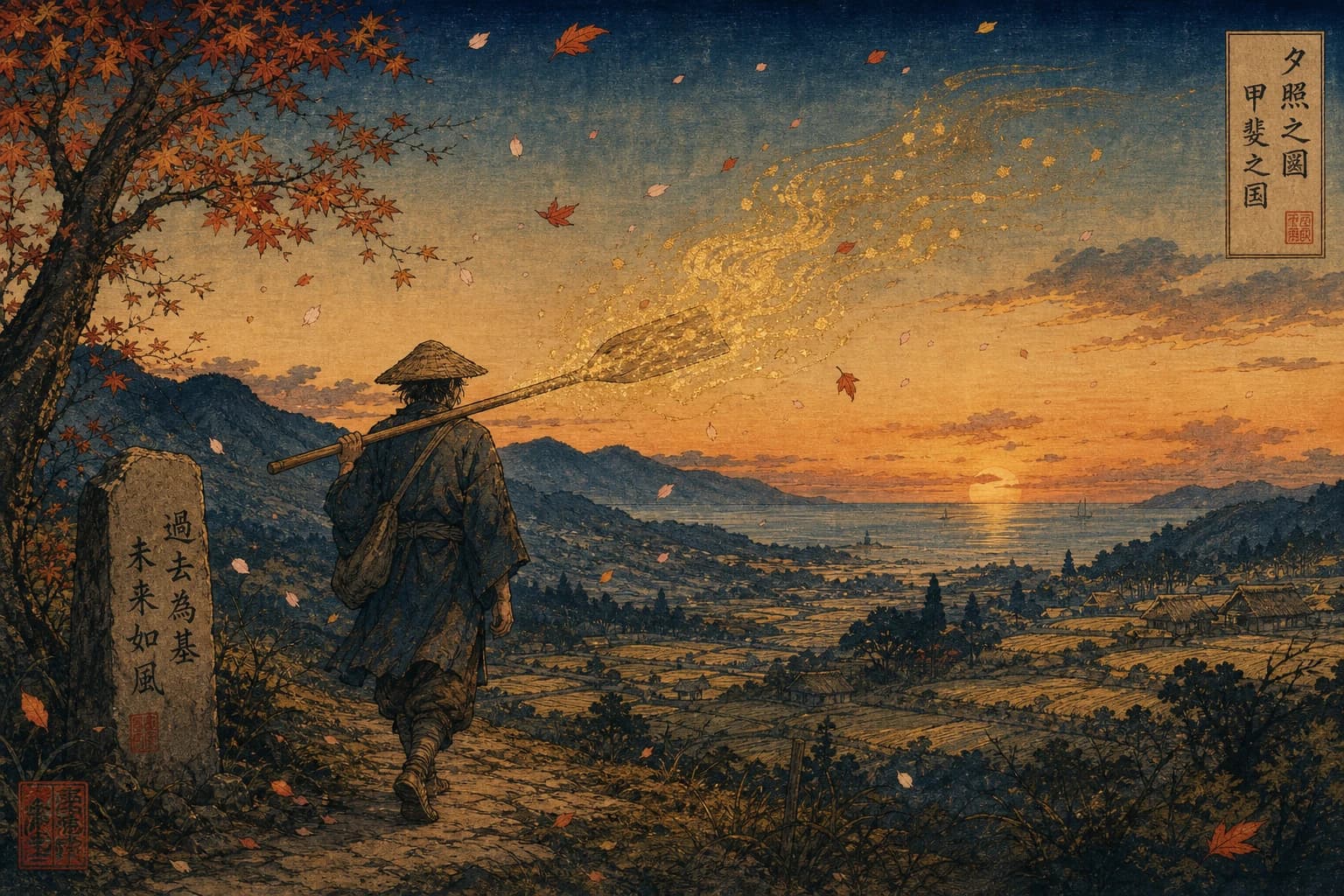
I want to sit with that image for a minute, because the oar is the tool of his whole journey. It's the symbol of everything the sea did to him and everything he did on that ship. And the instruction isn't "hang the oar on the wall as a relic." It's not "throw it away" or "burn it" or "never speak of it." The instruction is: carry it. Carry it so far and so long that you finally arrive somewhere where it doesn't mean what it used to mean, where the weapon of your past looks, to fresh eyes, like something that might be used for farming. And there, plant it and make peace with what you can't undo.
The Buddha told a story that I come back to over and over, about a man who builds a raft to cross a river. On the far shore, the man thinks, "Well, this raft saved my life. Should I continue to carry it forever?" And the Buddha asked, "Is that what the raft is for? The raft was for crossing over. Should you continue to carry it?"
This is a similar message, except it's different in the sense that Homer wrote the same teaching, but he was honest about the fact that sometimes you can't leave the raft there on the other shore. Sometimes some of the things that we carry, we're not able to set them down the moment that we want to, or the moment that we're told to.
In this case, the oar has to be carried inland for years. And carrying it beyond the shore isn't a failure. Carrying it is how it changes. You carry the past until the day that it stops being an oar. I just think there's something so beautiful and symbolic in that part of the story. Because that's the day you can plant it and say, "I no longer need to carry this with me."
And notice: the journey doesn't actually end at the homecoming, because even Ithaca isn't the finish line. As I've said before, you can get there, and then what? You keep going, because the path itself is the goal.
Closing Thoughts
So coming back to where we started: the past can't be undone. It can only be carried. What's done is done. But our relationship to the past is not fixed.
The same history can be a haunting or it can be a teacher. It can be a weight that we drag, or it can be the lesson that becomes the very ground that we stand on. The oar can remain an oar, or it can resemble a farm tool, and it's not because the past changed. It's because the person and the world changed.
Whatever we're each carrying, and we're all carrying something, the invitation is not to try to undo what's been done. The invitation is to keep walking with it, awake, until we reach the place where we can plant what we've been carrying and we no longer need to carry it.
And we don't have to sail the ocean for 10 years to learn this lesson. The lesson is quite simple: here we are in the present moment, and nothing is missing from this moment. Home is wherever we already are.
That's what I wanted to share with you. I hope you enjoy the movie as much as I did. That's all I've got for this episode. Thank you for listening. Until next time.