

Already Whole
Episode 223 of the Secular Buddhism Podcast
Hello and welcome to another episode of the Secular Buddhism podcast. This is episode number 223. I am your host, Noah Rasheta, and today I want to talk about the idea of being already whole. Specifically, I want to talk about two stories that I've shared on this podcast over the years, two stories that I recently realized might seem to contradict each other, and I want to tell you where I was standing when I realized it. As always, keep in mind you don't need to use what you learn from Buddhism to be a Buddhist. You can use what you learn to simply be a better whatever you already are. Okay, let's jump into this topic.
Standing Alone in the Kitchen
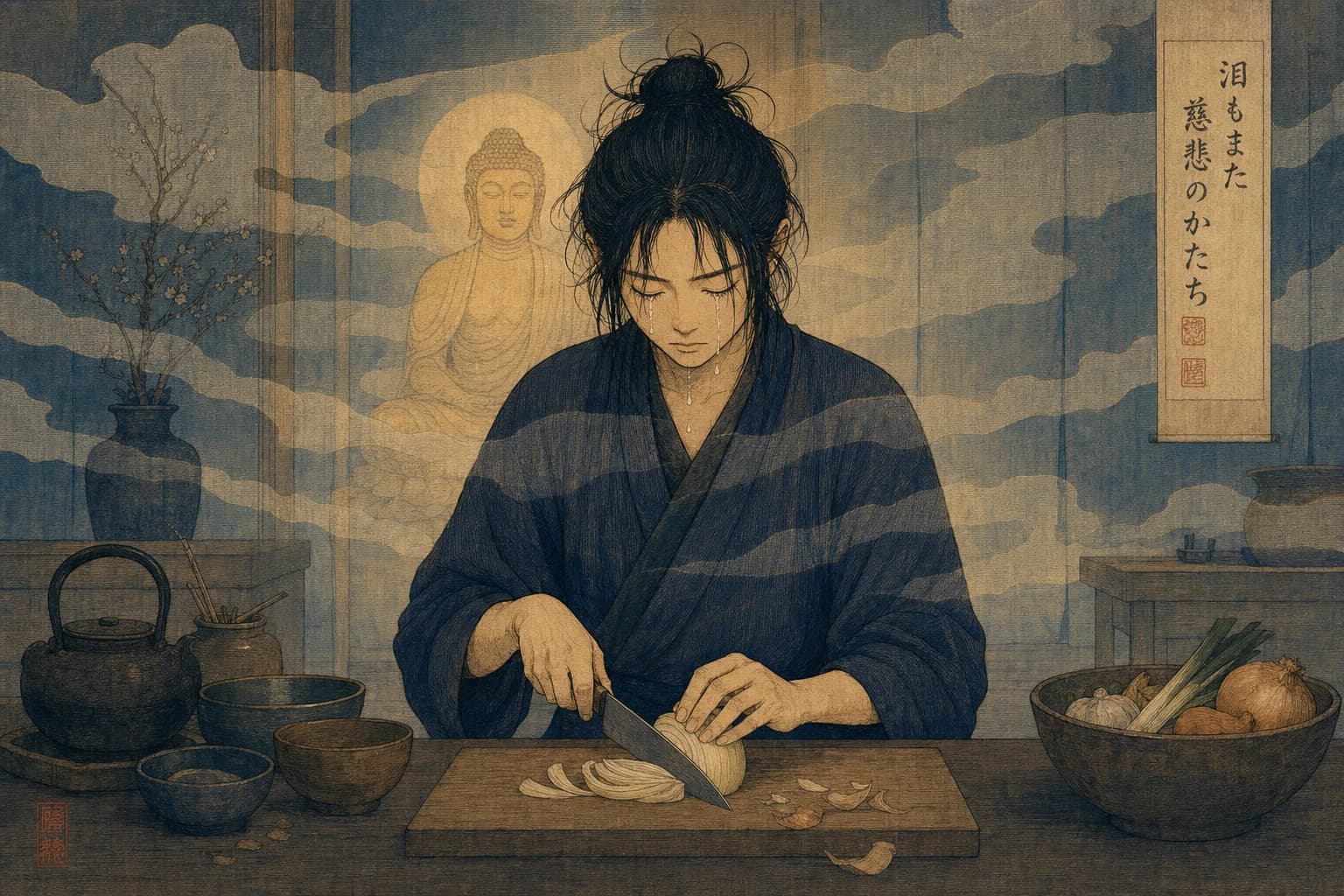
Several weeks ago I was standing in my kitchen making salsa, pico de gallo to be more precise. This is at my new place. And I was cutting an onion. Now if you heard the episode previous to this one, 222, "Holding Two Things at Once," you know that my life has changed quite a bit in the last few months. I've been living on my own now for a few months. And what I want to share today is what some of this new chapter has been teaching me, because I think it connects to something all of us bump up against at some point in life, in one form or another.
And here's what hit me while I was standing there in my kitchen. I'm currently 47 years old, and this is the first time in my entire life that I have lived alone. And I mean that literally. I came into this world with a twin brother, so I had a roommate before I was even born. I've never even had a womb to myself. I grew up with a best friend built into that relationship of a twin. During high school, I had best friends there. After high school, I served as a missionary, where I had a companion with me all day, every day, for two years. Then came college in Utah, where I lived again with my twin, and then moved in with my parents when my twin went to serve in Iraq. And I've always lived with someone. And then came marriage, and then kids, and a full house, and all the beautiful noise that comes with a full house.
So I've literally never lived alone, and now for the first time in 47 years, it's just me. Me in a quiet townhome with a cutting board, and I'm cutting an onion. And so there I was, standing, cutting the onion, and of course my eyes are watering. And I remember I kind of started laughing at myself, because I honestly couldn't tell how much of it was the onion. And maybe it wasn't just the onion, but holding two things at once, right? I was thinking about life and what it's like to be alone and what that means in terms of who and how I am. Who am I when I'm alone?
The Different Versions of Ourselves
Now, in the weeks since that night, I've been thinking a lot about this topic, and I've noticed that me, probably like everyone else, we're just slightly different versions of ourselves depending on who we're with. When I'm with my high school friends, I'm cracking jokes in Spanish and it feels like I'm sixteen or seventeen years old again. And when I'm with my college friends, I'm a different version of myself with different memories and different inside jokes. When I'm with my paragliding friends, I'm a different version of me and we're talking about different topics. When I'm with my kids, I have a lot of dad jokes and that unique sense of humor kind of emerges. And when I sit down to record a podcast, there's this version of me that you're listening to right now.
And none of these are fake, by the way. I mean, they're all the real me. But they're all slightly different, to varying degrees, from each other. And so when the house goes quiet and there's nobody here, and I don't have to be any version of myself in the context of a relationship to anyone else, that's when the question shows up for me: who am I when there's no one else in the room? Have you ever asked yourself that, or thought about that? Who are you when no one needs you to be anyone?
And I want to be clear about why I'm sharing this. I don't think my situation is unique in any way. Most people probably have experienced living alone, but for me that was a novelty, right? Because I'm a twin. So this is just my version of experiencing what probably everyone has experienced already. And maybe your version has already happened, or could happen again. We all go through these chapters, right? Where your last kid grows up and leaves for college and suddenly you're home alone. Maybe it's retirement, and the role that you played for 40 years suddenly ends on an ordinary day. Maybe it's the end of a relationship or the loss of a spouse. Or something as small as a weekend when everyone seems to be busy, so you're just spending time alone.
But sooner or later, life hands most of us the opportunity to stand in a quiet room, all by ourselves. And that's what I want to explore today. I'm going to lean on these two stories that I've shared before, and I hope by the end of this episode you'll have a fresh or new way of seeing yourself that makes that moment of standing alone in a quiet room feel a little bit different, and perhaps a little bit kinder.
The First Story: The Golden Buddha
To explain what I've been learning, I need to revisit these two stories, and I've told both of them on the podcast before in different episodes. The interesting part is that when I think about the two, on the surface it seems like they might contradict each other, but I want to explore that a little more in depth.
The first story is the story of the Golden Buddha. Some of you have heard this. Hundreds of years ago in Thailand, there's a monastery, and in this monastery there's a giant statue of a Buddha made of gold. And word arrives that an invading army is coming, and the monks know that a solid gold statue is the exact kind of thing an army is probably going to take. So they come up with a plan, and they cover the entire statue in a thick layer of clay and plaster, and they make it look like an ordinary clay statue. And sure enough, the army comes, the monks are killed, and the tragic part of the story is that everyone who knew about the Golden Buddha is lost.
For generations, supposedly roughly two hundred years, people walk past this statue thinking it's just a clay statue. And in 1935, supposedly, the statue gets moved to a temple in Bangkok, and for about 20 years it sits outside in a courtyard under a simple tin roof, because it was considered too plain to be displayed in the main hall. And this is the most valuable statue in the country, maybe one of the most valuable statues in the world. As it turns out, the people responsible for looking after it didn't notice that there was anything special about it. They didn't even put it in the main room. It was outside.
But then in 1955, they're moving the statue to a new building, and as the story is told, the ropes snap, the statue falls, the clay cracks, and someone looks into the crack and sees something shining back. And they chip away the plaster, and underneath is five and a half tons of solid gold. And it had been there the whole time. Today that statue sits in Bangkok, and the gold alone is worth well over a hundred million dollars. People come from all over the world to see this statue, and it's the same statue that everyone used to just walk past outside and not think much of.
(A note here: the specific dates and figures in this story, the two hundred years, 1935, 1955, five and a half tons, are the details as they're commonly retold. I'd flag these as the traditional version of the story rather than something to treat as precise history.)
Now, the way this story usually gets taught, and the way I've taught it myself, is that underneath that clay is the gold. The clay is your conditioning. All the beliefs you've absorbed, the fears, the criticisms, the stories about not being enough. Layer by layer, life plastered them on. And the work of the practice isn't to become something better, it's to peel away the clay and uncover what was always there. In other words, you don't need to add anything. You're already gold underneath. And I love that story. I've always loved that story. So that's the first story.
The Second Story: Peeling the Onion
And then the second story is a lot shorter, and it comes from Alan Watts, a philosopher I quote a lot on this podcast. He talks about peeling an onion. Imagine you want to find the core of an onion, the center, the pit. So you peel off the papery outside layer first, and then the next layer, and then the next one, layer after layer after layer. Of course your eyes are watering while you do this, and you keep going because you want to reach the thing at the center that all these layers are wrapped around. And you know what you find at the center of an onion, right? You find nothing. There is no pit. An onion is layers all the way down. And the layers aren't wrapped around the onion. The layers are the onion.
In Buddhism, this points to the teaching of non-self. The idea that when you go looking for that solid, unchanging core of who you are, the essential you that's underneath all the roles and the thoughts and the feelings, you won't find one. What you will find is layer after layer after layer. You find a process, like a river, which is never the same water twice, but is still somehow a river.
So now maybe you kind of see the problem. One story makes it feel like there is gold underneath your layers, that there's an essence of who you are. The other story is saying there's nothing underneath the layers. I think these are two of the most useful images I have ever found for talking about the self from the Buddhist perspective, and they seem to point in opposite directions. So which one is it? Is there something underneath which is whole and complete, like the gold? Or is it just layers all the way down?
Well, the answer I've arrived at, at least the way I've come to understand it, is: it's both. And seeing how both of these can be true at the same time is what I want to spend the rest of the episode on. Because I think this is the point where the teaching stops being a philosophy and starts being more like a healing concept, or a medicine almost.
What Peeling Actually Feels Like
So let's start with the honest version of what this actually feels like in practice. Because the Golden Buddha story, as beautiful as it is, sets up an expectation. It implies that one day the clay will crack and the light hits the gold and you see it and boom, you're done, right? This one big reveal. You've peeled off all the clay.
But here's what actually happens, at least in my experience. You notice a layer of conditioning. Maybe it's a belief you inherited from your parents, or a script you picked up in your teens, or a fear you've been carrying for so long that it just feels like an absolute truth. And you do the work. You see it, you question it, you peel it off. And underneath, you don't find gold. You find another layer of clay. So you peel that one too, and underneath that one, more clay. Anyone who has done real inner work knows exactly what I'm talking about. The peeling doesn't end. And at some point you start to wonder, is there gold? Where is the gold? When do I get to see this gold?
And let me make this concrete with my own layers, going back to what I shared earlier. There's the Noah of high school years, right? The Noah who is Noah when he's hanging out with friends in Mexico. There's the Noah who's hanging out with friends in Utah. There's the Noah who is paragliding. There's dad Noah. There's podcast Noah. Now, which of those is the real me? Well, all of them, and at the same time, none of them. If you peeled away podcast Noah, you wouldn't find the real Noah underneath. You would just find another Noah, shaped by whoever walked into the room next. It's layers all the way down.
The Five Aggregates
And it turns out Buddhism has names for these layers. There's a teaching called the five aggregates, and the idea here is that what we call a self is actually five processes running together.
There's the body, the physical layer. There are feelings, the constant stream of pleasant, unpleasant, and neutral. There are perceptions, the labels and recognitions, the part of the mind that looks at something and says, oh, that's an onion, or oh, that's a threat. There are the mental formations, which is kind of a fancy way of saying our habits, our scripts, the scripts that run our internal software, our stories and our opinions. And that's a thick layer, by the way. That one's most of the onion, I would say. And then there's awareness itself. The awareness, the knowing, of all of it.
And the invitation of the teaching is to look at each of those layers and ask a really simple question: is this me?
Is this body me? Well, it's completely different from the body I had at seven years old, and it'll be different again when I'm seventy years old. Okay, well, these feelings, are these feelings me? Hmm. They come and go like weather. I've watched an emotion arise, linger, and then dissolve in the space of a single red light. These perceptions and opinions, are these mine? Is this me? Well, I look at them, and most of them, I inherited. I can tell you where a lot of mine came from. And then these habits and these scripts? Well, those are just causes and conditions, patterns that got installed by repetition. And then even the awareness, the awareness that I can experience, it comes and goes. Literally every night when I fall asleep, anytime you transition between conscious and unconscious awareness.
So you go through all five layers asking, is this me? Is this me? Is this me? And here's the uncomfortable part. When you're done, there's nothing left to uncover. There's nothing left over. There is no sixth thing standing behind the other five saying, oh, over here, this is the real me. So again, you peel the whole onion and there's nothing there. There's no pit. So it sure looks like the onion image might be the most accurate. It's layers all the way down, and no gold in sight.
And I'll be honest with you, the first time that really lands for you and it resonates, it almost feels like bad news. Because, man, if there's no core, then what is there at the center of this whole experience of being alive? Did I just lose the most comforting story, which is that maybe there is an essential me underneath it all?
An Old Question
And here's the part I particularly find strangely comforting. This is not a new problem. People have been asking this exact question for probably thousands of years. There's an old Buddhist text where a student essentially asks the Buddha point blank: hold on, this teaching about a Buddha nature that's already whole and already awake, isn't that just the permanent self that you keep telling us doesn't exist, and it keeps sneaking back in through the side door? That seems like a great question, right? That's the exact question I was asking myself for a moment there in the kitchen.
And this question, again, has been asked before, and the answer given in that text I think is fascinating. The answer is essentially this: Buddha nature is another way of talking about emptiness. It gets taught in the language of gold for people who are frightened by the words "no-self" or "non-self."
Think about what that means for a minute, because the gold story and the onion story, I don't think, are rivals. I think they are two medicines for two different illnesses. If the thing you're suffering from is the belief that you are broken, that you are damaged goods, and that underneath everything there's something wrong with you that has to stay hidden, then the medicine you need is the gold story, the Golden Buddha. You're not the clay. The clay is just what got plastered on. But if the thing you are suffering from is the endless project of trying to find yourself and fix yourself, the constant search for the real you that's always one more self-improvement book away, then the medicine for you is the onion story. There was never a core to find. You can call off the search.
It's the same teaching, two different dialects, so to speak. And a good teacher picks the dialect based on what the student is afraid of. Some of us need to hear, hey, you're not the clay. And some of us need to hear, hey, there is no statue. And honestly, most of us need to hear both of those on different days.
You could also visualize the Golden Buddha this way: if that gold represents the purity of wholeness as emptiness, then the gold you'll find underneath is the fact that it's empty. So it's the layers all the way down. I like to think about it like that.
The Luminous Mind
But I think we can go one step further, and this is the piece that changed how I hold both of these stories. So stay with me here, because this is the heart of the episode. There's a line in one of the oldest collections of the Buddha's teachings that goes like this: "Luminous is the mind, and it is defiled by incoming defilements."
I love that line, and specifically I love that word "incoming." The greed, the fear, the self-doubt, the harsh inner critic. In that line, they're described as incoming. In other words, they're visitors. They are guests. They are not residents. They are not the structure of the house. And notice what the line is not saying. It's not saying there's a golden object buried somewhere at the center of you waiting to be excavated. It's saying the mind itself is luminous. The shine was never a thing underneath the layers. In other words, the shine of the gold is not the gold that makes it shine. The shine is a quality of the layers themselves.
And that leads to what has become, for me, the whole point of this episode. So I'm just going to say it plainly. No core means no broken core. And I'm going to repeat that, because I think it's easy to hear it and let it slide right past. With an onion that has no core, no core means no broken core. There is no part of you that needs to be fixed. Or as Alan Watts would say, the only part of you that needs to be fixed is the part of you that thinks it needs to be fixed, which is a layer, right?
So you see, the onion tells us what we're not. We're not a fixed thing with a center. And the Golden Buddha story tells us what that means: that there is nothing in you that is fundamentally broken, because there is no "in there" where a broken thing could even live. That deep, quiet belief that so many of us carry, the one that says, man, if people really knew me, they'd find that defective part at the center of it all. That belief requires the belief that there is a center, and there isn't one. The onion, which sounded like bad news, turns out to be the good news that the golden statue is pointing to all along.
Emptiness as Possibility
There's an old idea in Buddhist philosophy from a philosopher named Nagarjuna, and it's often paraphrased something like this: it's because nothing has a fixed essence that everything is possible. Now think about that one for a minute. If there really were a solid, permanent core of me, Noah, in there, then nothing about me could ever fundamentally change. I'd be stuck being that lump of whatever was there at the center forever. Whatever got written on it stays on it. The fact that I'm layers, causes and conditions, and that I am a process, not a thing, I think that's great news. That is the exact thing that makes growth possible. It makes healing possible.
And honestly, this whole new chapter of my life is filled with this sense of possibility because of that understanding of emptiness. Emptiness is like the blank canvas, and whatever's going to be painted on there now, that is the potential of whatever this painting is going to be. Right now it's empty.
What This Means for Practice
So what does this mean for practice? I think it means practice was never about mining, you know, digging inward. You're not going to dig in there to seek the thing that you're looking for, because there isn't a thing in there. But here's what you can do. You can notice when you are unintentionally applying new layers of clay. Every time you rehearse the story "I'm behind, everyone else has it all figured out," there you go, you're putting clay on yourself. That's a fresh handful of clay. Every time you tell yourself, "I'm just not the kind of person who can handle this," there you go, more clay. And the peeling mostly takes care of itself when we just stop adding new layers.
And I want to be honest about something here, because there's a trap, I think, in this teaching. Knowing you're gold underneath all the layers, or let's just say knowing that you are whole underneath all the layers, that's not an excuse to stop paying attention to the clay. Some teachers point out that people touch this idea of Buddha nature and then use it as an excuse to skip the actual work. It's like, okay, I get it, underneath I'm fine, so now I'm not going to put in any effort to change anything about myself. And I catch myself throwing fresh clay on all the time. Knowing this teaching doesn't stop my hand from putting on the clay. What it does is make me better at noticing when I'm doing it. And then I can say, oh wait, hold on, I don't want that, I don't need that. So that's what it is: noticing.
Why the Clay Is There
And then here's the last piece of this section, and I think this is an important thing. Ask yourself: why was the clay on me in the first place? So go back to the story. The monks didn't plaster the statue out of malice or ignorance or cruelty. They covered it in clay to protect it. The clay wasn't an act of vandalism. It was a form of armor.
And Tara Brach, a meditation teacher whose work I really appreciate, points at this part of the story and says the sad part isn't that we have the covering, the covering of clay. The sad part is that we forget the gold, and we start believing that we are the clay. And I think our layers of clay deserve the same understanding. They're armor. The defensiveness, the people-pleasing, the perfectionism, the thought "I'm fine, everything's fine." Those are not mistakes. At some point in your life, every one of those layers has been protecting you in a way that makes complete sense.
Almost like there was an army, so to speak, and some younger version of you did the smartest thing they knew how to do, and said, I am going to plaster myself in clay, and I will be protected. And I know this. I have done this myself. I can literally go back to specific chapters or points in my life where I see the clay that covered me, and it was done to protect me. And then over time, that becomes the new version of you, and you tend to forget that you were already whole and complete underneath, and the clay is just there protecting you.
So we don't take a chisel to ourselves and start attacking our own layers as if this is the enemy I'm fighting. I think it's a gentle process of peeling. If you had hardened clay on your skin, you're going to put water on it, maybe a soft cloth, and see if you can slowly wipe it away. It's a gentle process, and maybe even with a little gratitude: hey, clay, you were helping me when I needed it, I just don't need it anymore. And treat it the same way you would if someone came to you, someone you love, and they said, hey, help me get all this clay off of me. I was protected and hiding under all of it, but I think it's safe to come out now. Can you please help me? How would you treat that person? I think it would be a very compassionate process.
And I think that's what self-compassion looks like through this lens. You're not telling yourself, hey, you're wonderful, in the mirror. It's more like understanding why the clay is there in the first place, and noticing that the situation it was built for might not be there anymore.
Back to the Kitchen
So now let me take you back to that kitchen. The question was never how many people are in the room. The question is what are you living with in your own mind? And honestly, the more I've sat with this, the more I've realized that "alone" was never quite the right word for my situation anyway, because I live with this mind. I'm in a full-time relationship with thoughts and feelings and memories and moods and this entire layered onion of experience. There's a whole crowd in here.
And here's the thing. The longest relationship of my life, the only relationship guaranteed to last until my very last breath, is the relationship with my own mind, the relationship with my own self. It's not with my twin brother. It's not with my companions or life partners or potential marriage partners. So I've stopped thinking about this chapter as the start of a new chapter in solitary confinement. It's more like this: for the first time in my life, I have this roommate all to myself, and I'm getting to know every aspect of the roommate. Some days, I like this roommate. Some days, this roommate is not very easy to live with. But getting to know, in fact the process of getting to know, that is the practice. And I have to tell you, it's been one of the most fascinating stretches of my practice in recent years of my life.
Nothing Is Missing
So that brings me to one last thing about the onion, and then I'll wrap this up. An onion is not incomplete because it has no pit. Have you ever once looked at an onion and thought, you know, that's missing a center, so I probably shouldn't eat that? No, of course not. Because nothing is missing from an onion. It's completely an onion. Every aspect of it, every layer, is the onion. And I think that's what "already whole" actually means. Whole the way a river is whole, even though you can't grab it. Whole the way a song is whole, even though no single note is the song. I am not a fixed thing that got cracked and needs repair. I am a process, and the process is all here. Nothing got left out of this moment. Nothing is missing.
The Invitation for the Week
So here's the invitation for the week. And I'll give you two versions of it. One for the noticing, and one for the hard moments.
The first one is this. Sometime this week, catch yourself when you notice you are being somebody for somebody. You're being who you are in the context of work, or who you are for your kids, or who you are with a friend, or who you are when you're on the phone with a parent. It doesn't matter. But don't judge that. There's nothing wrong with that. Just notice: oh, okay, that's a layer of me. And who am I in that particular context? Then, the minute they leave or you hang up or something changes and someone else is there, notice that layer. Are you just recognizing that there are multiple layers? So that's one.
And then the second one, I think, is for the more difficult moments. Next time that voice shows up, because it will, the one that's like, hey, you're not enough, see if you can remember: nothing is broken in there. So the thought "you're not enough," enough of what? It doesn't even make sense. It would be like criticizing the pit of an onion and saying, hey, you're not good enough, or you're not sweet enough, or sour enough, or whatever. It's just completely irrelevant, because there is no pit of an onion. No core means no broken core. You don't have to win an argument with the voice in your head. It's just a visitor. It's just there. It's just saying things. You can let it be incoming, and then let it be outgoing.
The Retreat
And if this topic of "already whole" resonates with you, I do want to mention that this is exactly what we're going to be spending four full days exploring together in September at the retreat that I am hosting. The retreat is called "Already Whole: Discovering the Freedom Within," and it's happening September 10th through the 13th at Drala Mountain Center in the mountains of Colorado. The entire retreat is built around this teaching, the layers of clay we mistake for ourselves, and the practical tools that help uncover what's always been there. And you don't need any meditation experience or any background with Buddhism.
So if that's a topic that's interesting to you, join us. Space is limited, and last year's retreat filled up fast. So if you feel drawn to this topic, you can learn more at eightfoldpath.com. And I would love to share those four days with you.
Closing
And I want to close again by going back to that moment. I'm standing there cutting this onion, dinner for one, eyes watering, but I'm also kind of smiling, both happening at the same time. Because I had spent forty-seven years with someone always in the room, but hadn't noticed a lot. And here I was, finally meeting that one that's been there the whole time. I went looking for the core of me, and I found only layers, and as it turns out, that's the good news.
That's all I have for this episode. If this was helpful, share it with someone who's sitting in their own quiet room right now. And thank you for being here. Thank you for the years of walking this path together. And as always, thank you for listening. Until next time.
For more about the Secular Buddhism podcast and Noah Rasheta's work, visit EightfoldPath.com