

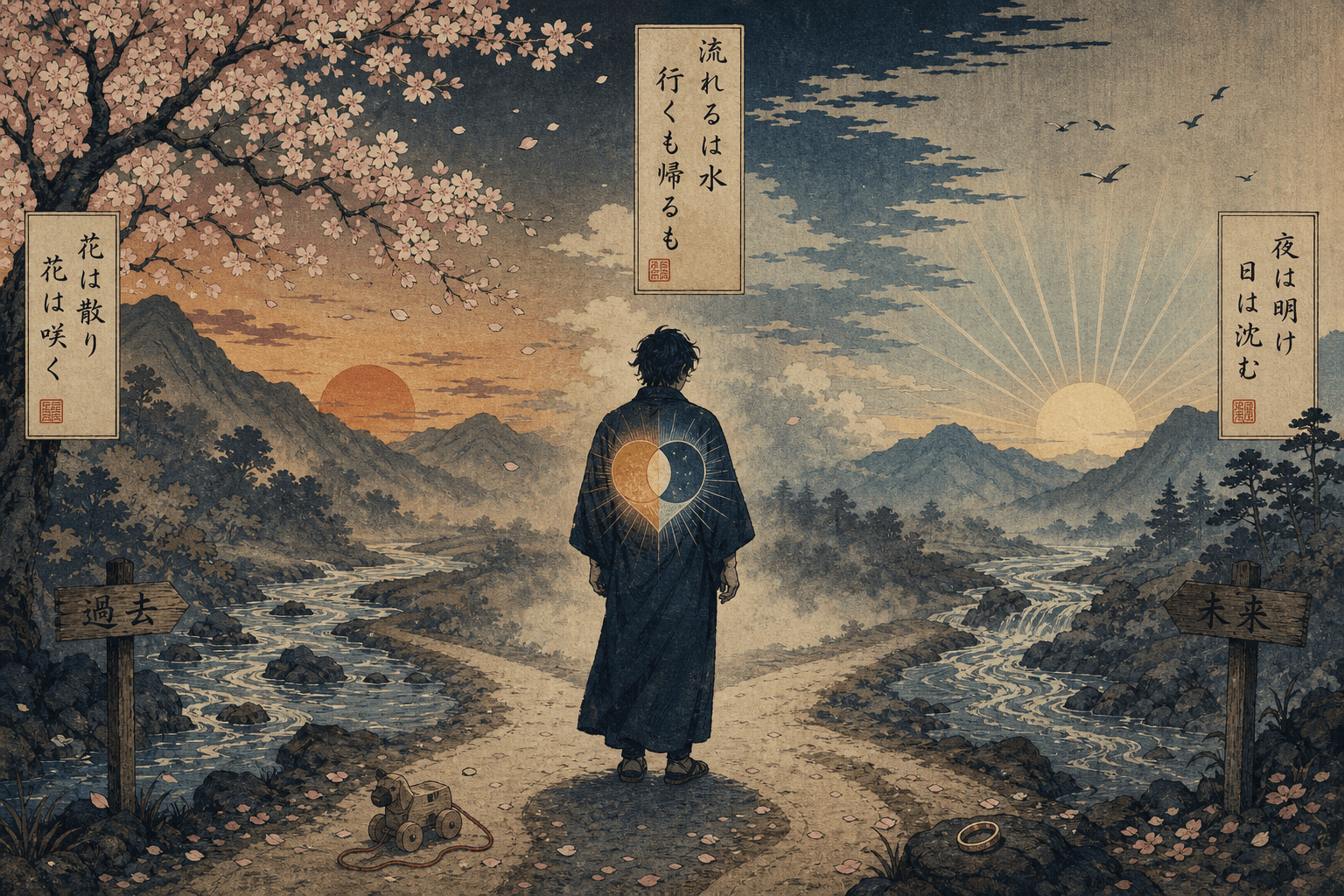
Holding Two Things at Once
Episode 222 of the Secular Buddhism Podcast
Hello and welcome to another episode of the Secular Buddhism podcast. This is episode number 222. I am your host, Noah Rasheta, and today I'm sharing a talk that I gave earlier today to my podcast community on the topic of holding two things at once, along with a personal life update that I wanted to share, not only with my Sunday call community, but with the podcast listener community in general.
I know many of you have been on this journey with me for many years, many of you since the very beginning of the podcast. So I wanted to share this update with you. Without further ado, this is the audio I recorded earlier, and I want to thank you for being on this journey with me.
A Personal Family Update
Before we jump into the topic for today, I want to share a quick personal family update with all of you. I think many of you have walked alongside my journey for a long time, since the early days of the podcast, and it feels right to share this directly with you in this space.
After a lot of thought and reflection, and deep respect for the life that my wife Giselle and I have built together, we've made the mutual decision to separate. It's not a sudden or a simple choice. It's something that we've arrived at together after many years of effort and honesty and a real desire to navigate our differences. And we've come to understand that we each need something that the other can't quite fully provide. We love each other enough to not want the other one to keep hurting.
Some of you who've followed the podcast for a long time know that about 16 years ago, we were nearly at the same crossroads for different reasons. Back then we chose to keep working, and I'm deeply grateful that we did. Because we stuck together for that chapter, we had three incredible kids, a lifetime of meaningful experiences, and developed a type of friendship that I think will continue even now, maybe in a different form. But this feels like the skillful, appropriate next step in our relationship.
Our priority throughout all of this is our kids. We remain a dedicated team for them. We're staying close geographically so their routines and their lives can be as stable as possible.
And that's where we find ourselves today. What I'd like to do is tie some of what I've been experiencing throughout this transition, which has been weeks and months now, into today's topic. I suspect that underneath what this moment feels like for me is something that many of us have navigated at some point in our lives, in our own way.
I'm sharing all this from a somewhat settled place. Emotions are always a roller coaster, with ups and downs, and I'm sure I will continue to experience that. But I'm not asking the community to hold something specific for me today. I'm just wanting to trust you with this information, the way that many of you have trusted aspects of your journey with me and with each other over the years. Because that's what this practice is for, right? Being here together for each other through the various pieces that life will throw our way.
Today's Topic: Holding Two Things at Once
The topic for today is the idea of holding multiple things at once, or holding two things at once. It's a question that I keep returning to over and over in my practice, especially in the last several months. It's a simple question that I think sometimes is surprisingly hard. And that question is: can I allow two things to be true at the same time?
What I mean by that is this. Most of us have been quietly trained, sometimes since we were small children, to take any moment and decide what we feel about that moment. As if every experience comes with a single correct emotional label, and our job is to figure out which one it is and then apply it.
When something difficult happens, we tell ourselves, "I'm supposed to feel sad," or "I'm supposed to feel happy," or whatever it is. As if any of the other feelings that show up alongside that particular feeling are a problem. Sadness might entail some relief. Relief might entail some gratitude, or even a flicker of joy. And we treat it like that's a problem, because we think, "Why am I feeling that? That feeling doesn't belong here." So we push it down, or we feel guilty about it, or we tell ourselves we must not be sad after all, because that's what we've been conditioned to believe.
The same thing happens in the other direction. Sometimes something good happens and we're celebrating something, and then a little bit of grief comes in that side door, or fear, or some old familiar form of pain. And we treat that as if it's the problem. We think, "Why am I feeling this right now? I should just be happy." So we push feelings down, or we feel guilty about it, and we tell ourselves we must not be grateful after all if we're feeling something other than happiness.
It works in both directions. And in both directions, we're doing the same thing: trying to make the moment simpler than it is.
Life Doesn't Come in Single Feelings
Here's what I've noticed: life doesn't come in single feelings, almost never. The moments that matter most are always two or more things at once.
A wedding, for example, is a moment of joy and a kind of small grief about everything that's ending. A graduation can be a moment of intense pride and a little bit of sadness at what's ending. The day that you bring a baby home from the hospital is a day of wonder and absolute terror. The day you bury a loved one that you loved, perhaps imperfectly, is a day of grief and a strange, complicated calm that includes feelings that you feel you're not even allowed to say or think out loud, because you think you shouldn't feel it.
So the big moments in life are almost always layered, and so are the small ones. If you look closely with the small ones, the cup of coffee you had this morning was warm and pleasant, but maybe you would have noticed that it's also one less morning you have left. The conversation that you had with your kid last weekend was funny and loving, but also a preview of every conversation you'll never have once they're gone.
Again, the idea of multiple things at once. It could be two, could be three, could be many more. Today I want to talk about the practice of holding two things at the same time, or multiple things at the same time, rather than collapsing them. Not choosing one and then pretending that the other isn't there. Not trying to resolve them into a single neat feeling. It's just allowing all of it to be there, to exist the way that it already does, whether we like it or not.
I think this is one of the most useful practices that we can develop. Because when we can't do this, when we insist that life comes to us in single feelings, we end up missing most of what is actually happening. When we can do it, even if it's just a little bit, we discover something that I think is one of the quietest, most underrated gifts of this kind of practice: the capacity to be fully present to a complicated moment without needing it to be anything else.
The Three Layers of Experience
So why is this so hard? Why do we keep trying to collapse the moment into one feeling when it almost never is one feeling?
I think there's a clue in something that we've talked about before with the three layers of experience. If you'll recall, there's the raw experience itself, whatever is actually happening. There's our awareness of the experience, which is the noticing. And then there's the story, the layer that comes on top of all of it: the meaning, the interpretation, the label that we place.
The raw experience is almost always multiple. Multiple sensations, multiple emotions, multiple thoughts arriving at once. The body holds all of it at the same time without any trouble. The body doesn't need things to be simple.
It's the story layer where all of this collapses. The story is where we want a clean answer. The story is what says, "Hey, this is a sad moment, so feel sad." Or the story says, "This is a happy moment, so you should feel happy." But the story is single, while the experience is multiple.
When we suffer in these layered moments, it's usually because we're fighting the experience with the story. We have a moment that actually feels like six different things happening at once, and we're trying to argue it down to one. That argument can be exhausting, and it doesn't work, because the moment keeps being whatever it actually is, no matter how hard we try to label it or simplify it.
Every Moment Is a First and a Last
There's another piece to this, and it's something I've come to believe is at the very heart of the practice. It's the recognition that every moment, without exception, is what you might call a first and a last at the same time. You might recall, this was the topic of a previous podcast episode I did several years ago.
What I mean is this: every moment we experience is happening for the first time. It's never happened before, not exactly like that, not exactly with these conditions, not exactly in this configuration. And every moment, as it's happening, is also the last. It will never happen again. The next moment, even if it looks familiar, will be its own first and its own last.
I had to learn this in a way I didn't choose several years ago, when I first thought about this topic of first and last after I lost my dad and a close friend within weeks of each other. I remember sitting with that realization that every conversation with my dad in those previous months was a first and a last, because we'd never had that exact conversation before, and we would never have that conversation again. Every dinner, every phone call, every word that was spoken or unspoken: all firsts and lasts every time.
What I found in the middle of all of that loss was that when I really let the recognition land, something shifted. It's not that the grief disappeared. It was still grief, but it stopped being the only thing in the room. Because right there next to it, very quietly, was something else. I could call it gratitude. Not the cheerful kind, not the kind that tries to talk you out of grief by saying, "Well, at least it wasn't that." It was a different kind. The kind that comes from recognizing or seeing that the moment in front of you is completely unique and unrepeatable, and that the only way to honor it is to be there fully with it, with however it's arising.
Once you see a moment that way, it's a lot harder to ask whether this is a pleasant or an unpleasant moment, because the question almost stops mattering. The moment feels so precious because it's unique and because it's unrepeatable. That's the whole reason. The feeling that comes with it, whether it's pleasant or unpleasant or both or neutral or all of the above, that's just the weather of the moment. The preciousness is the moment itself.
This is the doorway where grief and gratitude are not opposites. They share a doorway. And the doorway is the recognition that the moment is unique and it's not happening again. When you walk through that doorway, holding multiple things at once stops feeling like a contradiction. It starts feeling like maybe that's the most honest thing that you can recognize in a moment.
Examples From Real Life
To make this concrete, because I think this is one of the practices that's easy to listen to and nod to but maybe hard to actually experience or live, let me share some examples.
Think of a parent that's dropped their kid off at college for the first time. They drive home, and what is it they're carrying? If they're paying attention, it's at the very least four things. There's pride that their kid is doing what they're supposed to be doing. There's grief because the house won't be the same anymore. There's relief, because parenting this particular child maybe was a little bit more difficult. And then there's the low-grade fear, because we don't know what the future of that relationship looks like now. It's a genuine moment of uncertainty.
But in that moment, if you ask the parent how they feel, they're going to try to give a single answer. They're going to perhaps unintentionally lie a little, even to themselves, because they're either going to say, "I'm feeling proud," if that happens to be the emotion that feels the strongest, and they'll push the grief down. Or they might say, "I'm feeling devastated," because maybe grief is the strongest one they're feeling, and in that case they'll push aside the pride and the relief.
Either way, what happens is they miss the actual complexity of the moment they're in, which is a moment of multiple feelings and multiple experiences. The practice would be, in that moment, to allow all things to be just as they are, to not try to negotiate or rank these experiences that we're having, and instead just notice. "I'm feeling proud. I'm feeling sad. I'm feeling relieved. I'm feeling afraid." All of it is there.
Or think of someone who's caring for an aging parent. People who've done this know exactly how this feels. It can feel like this is tender and sweet, and also exhausting. It feels like sacred time, and also really inconvenient. It feels like this is love, and also a little bit of resentment. Sometimes all of it in the same hour. The cultural script will tell you, "You should only feel the noble part of that. This is just sacred and tender, and you should be ashamed if you're feeling anything else, if you're feeling exhausted or resentful." So then you spend half of your energy fighting your own feelings instead of just being present to the person that you're caring for and allowing all the feelings to be there.
Think about the death of someone that you loved, especially if it's a form of imperfect love. Maybe a parent that was difficult, a sibling that you didn't always get along with. Again, the cultural script here says grief, and only grief. That's the only appropriate response. But again, the honest response might be a little more complicated. Sure, there's grief. There's also a little bit of freedom, maybe, that you're not supposed to admit to. There's anger about the things that will never be repaired. There's love. And maybe there's a little confusion. All of it is there, all at the same time.
Think about somebody who's finishing up a long project, maybe writing a book or finishing a degree. They've worked toward this for years, and then one day it's all done. There's the sense of accomplishment. Maybe there's also a sense of a little bit of unexpected grief that the thing they've been working so hard toward is now done. We talk about post-graduation depression. That's a thing. We talk about concepts like the empty nest. That's a thing. These are all just names that we give to the experience of holding, or attempting to hold, multiple things at once, but not having the language for it.
The Version I'm Living Now
And then, of course, there's the version that I happen to be living right now, which is the ending of a marriage that mattered.
What I'm carrying, if I'm honest about it: deep love for the family that we've created. Deep respect for a partnership that's given us three kids. And at the same time, a settled understanding that this is probably the skillful way to end this chapter. Grief for what's ending, gratitude for what was, hope for what might come next, tenderness for the kids who are walking through something they didn't choose.
It's all of it. All the feelings, all there, all at the same time. If I tried to pick one of those feelings, which one is the right one to feel, I'd lose the truth of the moment. If I made it only about grief, I'd erase the years of real love and real meaning that we've shared. If I made it only about the sense of relief and hope that I feel, that would erase the weight of what's actually happening and what's actually ending. The moment is asking me to hold all of it, and that's the practice.
I'm offering this again, not because my situation is special, it's not. I'm offering it because this is a version of something that almost every single person listening to this is doing right now in one area of your life or another, or will be doing at one point in one area of your life or another. Holding multiple things at once.
I think we've been trained to think that we should simplify this down to one, that one thing has to win. So we end up spending energy trying to decide which one. The practice today is: what if we just stop? Stop deciding what exactly it is that we're feeling, and instead turn inward, notice.
Holding Contradictions About Ourselves
The hardest version of this practice is the contradictions that we sometimes carry about ourselves. Most of us, if we're honest, carry at the very least two competing stories about who we are at any given moment. For example: "I'm doing well, and I'm struggling." Or, "I've grown a lot, and I'm still wrestling with the patterns I've been wrestling with for 10 years." Or, "I love who I'm becoming, and I'm disappointed in who I still am sometimes." Or, "I'm at peace with my life, and also I'm really afraid of what comes next."
The mind hates this. The mind wants a verdict. The mind needs to know: "I'm a good person for what I'm doing, or I'm not. I'm doing well, or I'm not doing well. This is the right path, or this is not the right path." It wants one answer.
And again, the practice, the one that we've been circling here for a long time now, is just to recognize that the answer to all of these questions is almost always both. Yes, you're doing well and you're struggling. Yes, you've grown and you're still a work in progress. Yes, you love your life, and yes, you're afraid of what's changing in it. It's both, at the same time, always.
When we stop trying to choose, something can relax inside of us. Because the energy that we are spending in the courtroom case of the mind for yourself gets freed up, and you can use it to pay attention to the moment that you're actually in. Notice the complexity of that moment. What all is happening right here, right now?
I remember feeling this with my dad when he passed away. There was this tremendous amount of grief, but there was also gratitude, and there was also humor and laughing at some of the memories and his jokes. It was this incredibly complex moment of a multitude of emotions, and it felt so wonderful to contain the space for all of them. I find myself feeling that again in the complexity of this moment, with all of the emotions and all of the feelings.
The Practice: What Else Is Here?
That's the invitation for the practice for this week that I myself am working quite intimately with. Notice yourself in a moment where you're being asked intellectually or mentally to try to distill this down to one specific thing, and notice that that's the cultural script for what you're feeling or what you're supposed to feel.
In that moment, pause. Ask maybe the quiet, real question. In addition to what you think you're feeling, say, "What else is there? What else is here?" Not what else should be here, and not what am I allowed to feel, or what am I not supposed to feel. Just ask: what else is actually here? If I'm being completely honest with myself in this moment, what else is here?
I think you'll find that you'll be surprised how often there is a second feeling waiting just under that first one, under the obvious one. Then you look closer and there's a third one just under that. This process can go on and on. You don't have to grade them. You don't have to pick them. You don't have to rank them. You don't have to resolve them or collapse them into one. You just let them all sit there in the room together, for one breath at a time.
That's it. That's the whole practice.
An Evening Ritual
There's an evening ritual that I think goes along with this, that I've been doing, if you want to try it this week. At the end of the day, write down one moment where you noticed there were two or more things that felt true at the same time. Name them. Don't analyze them. Don't rank them. Just label them and notice that they were both there. "I felt this, and I felt that."
Over the course of a week, if you do this daily, you'll have seven examples of your own life refusing to be simple. That's a beautiful thing. That's not the problem. That's the texture of being alive. It's the experience of being human. The practice is just learning to be present to that texture without arguing against it.
Closing Thoughts
I want to close this with one more thought. The world we live in is going to keep handing us moments that are layered. There will be births and there will be deaths. There will be beginnings and there will be endings. There will be moments that feel like wins, and moments that feel like losses. There will be hellos and goodbyes. Sometimes they happen within the same hour, within the same breath.
The question is never whether life will be complicated. Of course it is. It already is. It always has been. I think the question is whether we can be present to the complication without needing to flatten it into something easier. Because two things can be true at the same time, and most of the time they are. When we can hold both, we get to fully be here. When we can't, we trade the moment that we're actually in for the simpler moment that we wish we were in. That trade, repeated over a lifetime, is probably one of the quietest sources of suffering that I can think of.
So this week, let's practice not making that trade. Let the moment be whatever it actually is. Let the feelings be whatever they actually are. Notice when there's more than one. Notice when there's grief inside the gratitude, and notice when there's gratitude inside the grief. Notice when there's joy sitting right next to the heartache. And notice that they're not bothering each other at all. They're both there.
That's the practice. Holding two things at once, or three, or four, or as many as life happens to be putting in your hands.
I want to thank you for being here. Thank you for receiving this update with grace. And thank you for the years of shared practice that have made a space like this even possible, where something like this can be openly shared. That too is two things at once: this is a community, and it feels like a kind of family.
So that's what I wanted to share with you today.
For more about the Secular Buddhism podcast and Noah Rasheta's work, visit SecularBuddhism.com