

You Are Good, You Are Enough
Episode 219 of the Secular Buddhism Podcast
Hello and welcome to another episode of the Secular Buddhism Podcast. This is episode number 219. I am your host, Noah Rasheta, and today I'm happy to share an interview I had with author and meditation teacher Lodro Rinzler about his new book, You Are Good, You Are Enough.
Remember, as always, you don't need to use what you learn from Buddhism to be a Buddhist. You can use it to be a better whatever you already are.
A Note Before We Begin
Now, before I get into the audio of the interview, I want to be upfront about something. This interview is a little different from a typical podcast episode, because I made a mistake.
I sat down with Lodro. We had a wonderful conversation. And about 25 minutes into the conversation, I realized I had never hit the record button. I just totally overlooked it. So the first portion of our conversation, which was really great, is gone. What you're about to hear is the remaining 45 minutes or so of that conversation, picked up right where I caught the mistake and hit the record button.
I share that because I don't think you'll notice a gap. We had an incredible conversation that flowed really well. But I think it's very fitting that the topic we were on was, first of all, a book whose central message is that you are already enough. And meanwhile, the person hosting the interview couldn't even remember to press record. If that's not a reminder that we're all just doing our best imperfectly, I don't know what is.
About Lodro Rinzler
Lodro Rinzler, if you're not familiar with his work, you may know him from his earlier book, The Buddha Walks into a Bar, which was actually one of the first books of his that I encountered years ago. Lodro has been a meditation teacher for over 25 years. He leads an online community called the Basic Goodness Collective, and he writes a Substack called The Laundry. He's someone who, like me, is passionate about making these teachings accessible and practical for everyday life.
His new book, You Are Good, You Are Enough, is built around a concept that's central to Buddhist thought: the idea of basic goodness.
The Story of the Golden Buddha
The way he frames it in the book is through a story that many of you may have heard before. It's the story of the Golden Buddha.
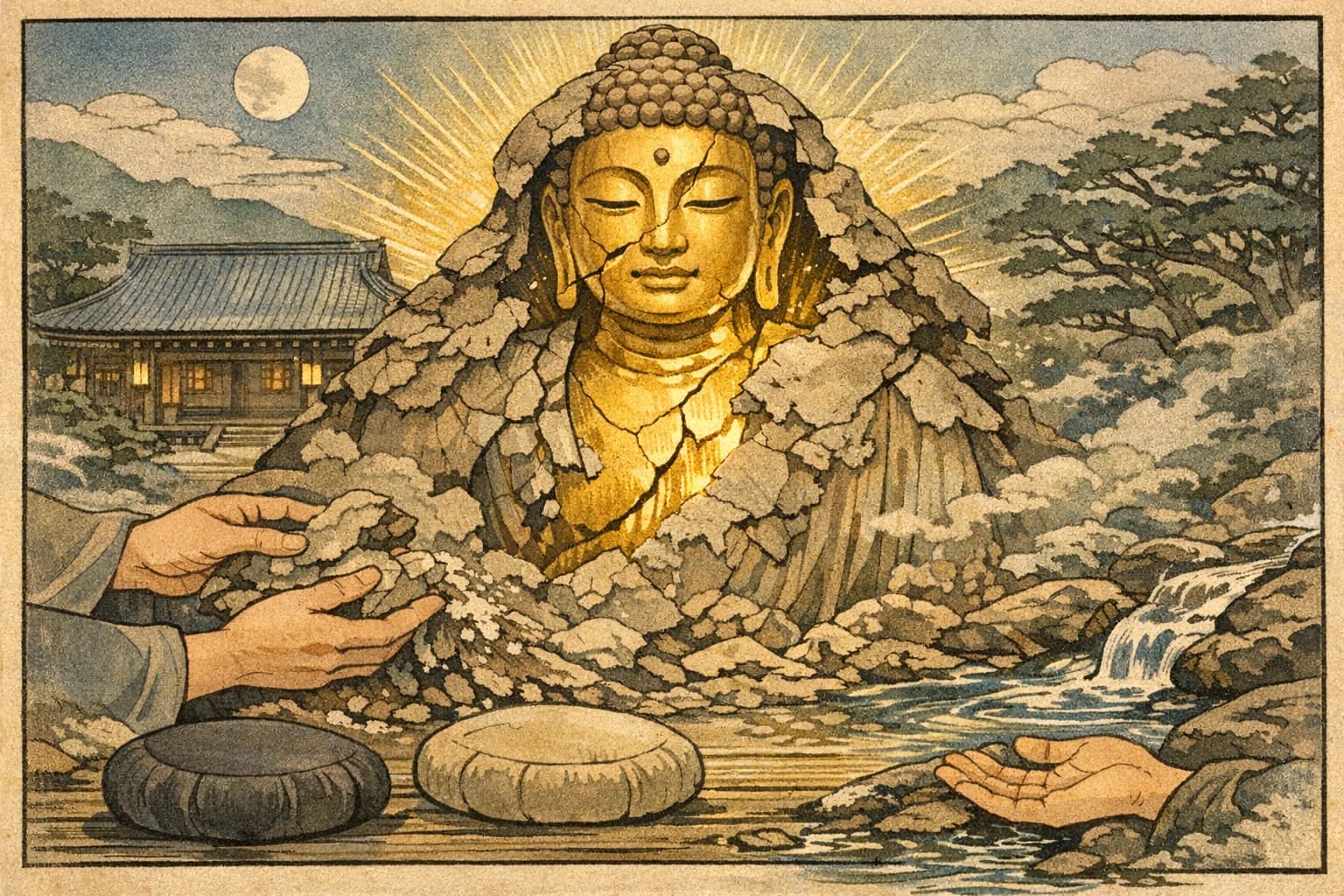
There's a real statue in Bangkok, in a temple, and it's a massive Buddha, about 10 feet tall, weighing five and a half tons of solid gold. But for roughly two hundred years, nobody knew it was gold. Centuries ago, when the Burmese army was invading, the monks covered the entire statue in a thick layer of clay and plaster to protect it from being stolen or destroyed, and it worked. The invaders passed it by. But all the monks who knew the secret were killed or scattered in the invasion, and so the knowledge of the golden Buddha underneath the clay was lost.
For generations, people looked at the statue and saw nothing remarkable, just a clay statue. It sat outdoors under a tin roof at a temple that nobody paid much attention to. Then in 1955, when they were trying to move the statue to a new building, the rope snapped, the statue fell, the clay cracked, and one of the monks noticed a golden gleam shining through. They started chipping away. And what they uncovered underneath all that clay was one of the most valuable Buddha statues in the world, made of pure gold. There it had been the whole time.
That story is essentially the premise of this book. Lodro's message is that we are like that statue. We come into this world whole, complete, and inherently good, and then over time, life layers on the clay: conditioning, expectations, societal messages, family dynamics, beliefs about ourselves that aren't actually true. All of that is like the clay. And at some point, we forget what's underneath. We start to believe we are the clay. We look in the mirror and we see something lacking, something that needs to be fixed, something that's not quite enough.
Our entire culture reinforces this. Marketing, social media, even some spiritual traditions all operate on the assumption that fundamentally something is wrong with you, and if you just had this product, this belief, this faith, this achievement, then maybe you'd finally be complete. Lodro's book challenges that assumption at its root. The message is not that you need to add more layers or to gain anything in order to become whole. It's that you need to start peeling them off. Because underneath all of it, you already are what you've been searching for. You're not the clay. You're gold.
Setting the Scene
In the part of the conversation that was lost, we had been talking about doubt, specifically the kind of doubt that shows up as the voice in your head telling you that you're not enough. What I love about the Buddhist tradition is that it introduced me to a different relationship with doubt. There's a Zen expression I've mentioned before that says, "Big doubt, big awakening. Little doubt, little awakening. No doubt, no awakening."
So doubt itself isn't the enemy. There's a skillful kind of doubt, the kind that keeps you curious and open. But there's also the unskillful kind, the kind that convinces you that you're fundamentally broken or fundamentally lacking. That is what Lodro refers to in his book as the trap of doubt. And that's exactly where the conversation picks up.
You'll hear us talking about imposter syndrome, about the voice that never fully goes away but doesn't have to be the voice that's driving everything. You'll hear a fascinating discussion about how naming something, like the color blue, actually changes what you're able to see. And you'll hear Lodro talk about the Tibetan word gom, which is usually translated as "meditation" but actually means "to become familiar with." The whole idea being that meditation isn't about stress relief or self-improvement. It's about becoming familiar with who you really are underneath all that clay.
I think this is one of the most needed messages of our time. In a world that profits from making you feel like you're not enough, the reminder that you already are, that you always have been, is revolutionary. And it's not just about believing it for yourself. As you'll hear in our conversation, it gets even more powerful when you start to see that same gold in everyone else too.
So without further ado, here is the audio from my interview with Lodro Rinzler, author of You Are Good, You Are Enough. If this conversation resonates with you, I'd encourage you to pick up the book wherever books are sold. You can also visit LodroRinzler.com/you-are-good for free guided meditations from this book. All the links will be in the show notes.
The Trap of Doubt and the Voice of "Not Enough"
Lodro Rinzler: I had a conversation not that long ago with Joe Kelly. Joe Kelly is the current writer of Spider-Man comics. And he has written a ridiculous number of comics. I'm gonna say five hundred, something like that. I told him, "I looked this up. Five hundred comics. How does that feel?" And he goes, "Oh, it's good." But then he said, "Here's the thing. Every month when Spider-Man hits the stands, I still have some voice that says, 'Is anyone gonna read this? If they do pick it up, are they gonna hate it? Are they gonna find something I did wrong? Are they going to roast me on the internet because they don't like what I'm saying?'" He's like, "That's a very real possibility."
I said, "So how do you deal with that voice? Because it happens literally every month." For me, I release a book every couple of years, maybe. But every month? He said, "It's more about how much attention I give to it. It's not that it doesn't come up. It's that I don't let it dominate."
So I think of this a little bit like: there are going to be moments where that insidious voice of not-enoughness comes up, where the trap of doubt grabs a hold of us. But it's sort of along for the ride. It doesn't get to drive.
And I think that is where meditation has actually helped. Because a lot of times we want to excise the doubt, the bad feelings, all of it. The little voice that says, "But what if this happened?" That seems pretty impossible to me, to just get rid of the thoughts. Everything I've heard from meditation teachers I've studied with is: you don't get rid of thoughts, but you can befriend them. And the more we allow space for them to come and go, the more likely they are going to go. If we don't cling to them, if we don't cling to those stories, then they start to get disempowered and go away. So again, the trap of doubt doesn't get to drive. That's the main thing I've learned over time.
Even though, again, I always joke that you write a whole book on a topic and then the topic's really in your face. I wrote a whole book on heartbreak and I was like, "Man, really mired in my heartbreak, everyone else's heartbreak. This is a thing." You write a book on basic goodness, I just feel good all the time. But then also, the other half of this is you're also writing about the trap of doubt. That voice: "Will anyone read this? Will anyone care? Will everyone hate the idea that I wrote a book on basic goodness and say it's too Pollyanna?" That comes up. But again, that voice doesn't get to drive.
Noah Rasheta: I love that you bring up the fact that the voice doesn't go away. It's always gonna be there. But it doesn't have to drive. And I think for anyone listening to this who maybe would make the mistake of thinking, "Okay, I need to read these things or practice meditation so that I can get rid of the voice," I think it's a really comforting thought to recognize the voice doesn't go away.
Lodro Rinzler: I know. I feel that's the most Buddhist thing: "Isn't that comforting that you don't get to get rid of the thing that you wanted to get rid of?"
Noah Rasheta: Yeah, you're right. I feel it anytime I'm gonna record a podcast or do a Dharma talk with my online community every Sunday. When I'm thinking of the topic, the voice is always saying, "Well, who are you to be saying anything?" And I've changed the relationship I have with it. At first it was like, "Oh crap, I didn't think about that." And now it's like, "Yeah, it's you. That's fine. I get it." And the truth is, yeah, who am I to say anything about anything? But who am I to not say anything about anything? I'm not selling anything. I'm just sharing what comes from the heart, what came into the mind, and there's no agenda. What could be wrong with that?
It's Not About Us
Lodro Rinzler: I wonder if this is a similar thing for you, because I also have that. I lead an online community called the Basic Goodness Collective. I'm offering talks every week year-round, and we meet for meditation twice a week. It's a vibrant community. And there is some sense of, "Oh gosh, who am I to be essentially the figurehead of this thing?" But at the same time, the thing that lets me off the hook is: it's not about me. It is absolutely not about me. It is everything about the teachings. And I just happen to be the current person in the room offering access to that thing in this particular moment. The more the community has grown, the more other people are leading meditations and things like that, I'm like, "Oh great, it's becoming more and more diffuse." It's not about a Lodro community. It's a basic goodness community. And they're actually just really happy to be in community with each other. So there's almost like it's not about me at any point. This book is not about me. This book is often about this community, actually, because this is the place I've been having basic goodness conversations for the last, how long has the community been around, seven years?
Noah Rasheta: No, that feels totally relevant. I find great joy in the witnessing of somebody taking these concepts and ideas. For me, it's very common in my community. There are people who are disaffected with religion. They encounter the term "secular Buddhism" and it feels safe to them. "I don't want another ism in my life." These ideas, oh, these are great ideas. And then they start to marinate in the worldview of Buddhist thought. And then they kind of emerge out of here and go into, you know, some people will go find a particular tradition that speaks to them, like Plum Village or whatever it is. And I love it because I think of that parable of the raft. It's like: if this is the raft and it's helping you get to wherever you're going next, let go of the raft when the time is right.
I see that in the community members who, I don't know if "graduate" is the right term, but it's almost like this was a stepping stone to whatever's next. And many of them go on to say, "Let me present this my way," and then they have their community or their meditation group. I love that. Because just like you mentioned, it's not about this group. It's not about me. It's not even about them. I start every episode with this expression: you don't need to use what you learn from Buddhism to be a Buddhist. You can use it to be a better whatever you already are. That to me is the heart of what makes all of this content so powerful. It's empowering people to be a better version of themselves, whatever that is. Believer, non-believer, deeper into Buddhism, further away from Buddhism, it doesn't matter. You can be a better whatever you already are.
And I think the core understanding that someone could take that could truly change their life for the better is exactly this: you are good. You are enough. And then if you sit with that long enough, you realize, "Oh, it's even more than that. I am everything that I need to be. There's nothing lacking." I love that.
The Revelation of Basic Goodness
Lodro Rinzler: Yeah, beautifully said. And it is a really powerful thing to wrap our head around. I've had these experiences where I'm in a room, I'm offering this as a teacher, and someone just breaks down crying because they have so internalized the story that there's something basically messed up with them. And the idea that someone's saying, "Actually, there's this whole tradition that says this thing. And you can experience it in meditation. Here's how. You are inherently good. That's actually who you are." Again, tears. It is a revelation for many people.
I shared a story in the book about my friend Neil, who I've known for a decade now. When he first heard this story, it hit him because he is queer and he grew up in a culture where, even if it was somewhat accepted, there might have still been some undertones and some messaging that he received and internalized, that there was something sort of wrong. He came out and has lived a wonderful, confident life as a gay man. But hearing the idea of, "Actually, by the way, yes, you are inherently good. That's actually who you are. There's nothing wrong with you," just unlocked something maybe very subtle and deep in him. At least that's how he's described it to me, that he didn't even know he was holding.
And I think we all have some version of that. Even if you're not a raging, anxious person who has a lot of thoughts of, "What are people thinking about me?" those sorts of insidious thoughts can occur. And if you're the sort of person who is not that, I bet there's still something deep inside that is saying, "Oh, but there's something fundamentally not right." And that is something we need to let go of. I always find that Buddhism is less of a cultivation of things and more of a letting go of things. Letting go of those stories allows us access to our Buddha nature, to our basic goodness. It allows us to be kinder, because we're less held in the trap of doubt. It allows us to be more loving as individuals.
Peeling Away the Clay
Noah Rasheta: Yeah, that's the beauty of the Golden Buddha statue, right? You're not trying to add anything. You're trying to peel away and remove, because it's only through the process of removing that you'll ever start to see the totality of that gold that you are.
And to me it makes sense with the society and the upbringing that we have. The governing view that our society has adopted is one of lacking. "Hey, let me present you with the dilemma. What's the dilemma? Something is wrong with you. But guess what? Here's the thing that can save you from the problem." That's the worldview that our society is steeped in. And it extends beyond the belief systems and the worldviews. It's embedded deep in the DNA of our societal views. "Your life is okay, but it could be better if you had this product, this solution." That's the engine that drives all of marketing: feeding off of our inherent sense of lacking.
And I think some people approach even Buddhism or meditation still with that fundamental view that something is lacking. "Maybe this will be the thing that gets me across the line." I love seeing that moment in people's lives where they realize, "Wait a second, this is an entirely different view. This view is telling me I'm not lacking."
People start to come to understand it, and there's that first unlock moment where you're like, "Oh, I'm gold, I'm not clay." And then creeps in the little bit of doubt: "Okay, well, maybe I'm gold, but I don't know if it's real gold. Maybe this is fool's gold." And that's the doubt you're talking about. And then comes the moment where you realize, "Yeah, I really am enough." To me, that's synonymous with awakening and enlightenment. It doesn't need to be anything other than that one shift in the realization that I don't need anything. Everything is perfect the way that it is.
Second-Guessing Our Own Goodness
Lodro Rinzler: Something that occurred to me as you were saying that is, I mentioned earlier that this is an experience you can have. And one thing that people doubt is their experience of basic goodness, which is a really interesting one. It's exactly like, "What if it's fool's gold?" as you said.
There's something so ordinary about the experience of touching in with Buddha nature or basic goodness. We're sitting on the cushion, for example. We're with the body breathing. And then there's just this moment where we feel relaxed and it's okay for us to be there. In that moment, it's not that there are a lot of thoughts. It's just a sense of openness. "I'm okay in this moment. I'm fully open in here." And then we second-guess and go, "Is this what Buddha nature is?"
When I was a kid, my precocious child that I was asked my mother, "How did we get here?" And her very Buddhist answer was, "There was wakefulness and then we second-guessed it." And that's basically what we do on the cushion. We have moments like that. We say, "Is this the thing?" And then we second-guess and say, "That can't be the thing. I couldn't be enlightened. I couldn't be awake in that moment." But what if it was? That's why I'm pausing. What if that is the experience? What if it's so ordinary and it happens all the time, and then we just miss it?
Having discovered and developed some sense of trust in that, can we then start to notice it elsewhere? Can we notice it in the moment when we're in the shower and the hot water hits our back and the muscles start to relax and we feel okay in that moment? There's not a lot going on in our head or our body. We're just there. Could we notice it, going back to the fatherhood of it all, when my child, just right before this, insisted, "Hey, you're running off to work. I need a big hug right now." I was like, "Okay." And then I was three minutes late because I was like, "I'll set all the stuff up later. I'm just here for the big hug." That's a moment of basic goodness.
The more we start to notice it, the more we develop a continuity of experience, which is that sense of wakefulness in everyday life. That sense of, "Oh, this is an on-and-off-the-cushion experience of just being fully present for my world and, within that, finding the goodness that's already here."
Meditation as Becoming Familiar
Noah Rasheta: I love that. That brings me to something you brought up in the book. The Tibetan term gom. Can you talk about that?
Lodro Rinzler: Yeah, that hard "O." Gom.
Noah Rasheta: "Stop trying to meditate." Speaking to that, a shift in my relationship with meditation was when I realized I don't have to do this. I don't need it. I get to do it. And trying to compare, what other things in life are like that? Kids, you see it all the time. They're doing the thing that they want to do because they're playing or they're curious, but they don't have to. The moment you have to, it's a chore.
I thought, what in my life is a thing that I just do because I can? For me, it's paragliding. That's my passion, my hobby. I love it. I don't have to do it, but it's something I choose to do because I enjoy it. And this is where I want to start the process of turning this outward and looking at what we see in others.
The realization that you don't have to paraglide. I could share my joy and show you the videos, and you might say, "That looks incredible. I want to do that." And then, "Let's talk about it, I'll teach you." Or you could say, "That looks terrifying. I'm afraid of heights. I don't want to do that." And I'd be like, "Then don't. You won't like it if you're afraid of heights."
But to be able to find the thing that lights you up, that you just get to do, you don't have to do it, you get to enjoy it. That transformation, that connection, that moment of realizing: that's what paragliding is for me. That's what meditation is for me. Not because I have to. I enjoy it. And not always, just like I don't always enjoy paragliding when the weather's not good. That's the last place I want to be. It's actually quite scary. And meditation has been transformed a bit for me in that same way. Sometimes it'd be like, "No, now's not the right time. I've got to take my kids to soccer and to dance and all the crazy hectic stuff." It's not a thing to have to do. It's an experience that from time to time I get to enjoy. And sometimes it happens in the middle of the chaos and the hecticness, because I've realized it's actually not sitting still away from the chaos. Sometimes it's just observing the chaos. It's just observing whatever is. And whatever is, sometimes, is a cushion and it's quiet and it's peaceful. Sometimes it's all the chaos and there's something else I just noticed.
Extending Basic Goodness to Others
Noah Rasheta: So with that and getting to pointing this outward: extending the understanding of basic goodness to others. Because I suspect the hardest chapters for some readers might be the ones about extending basic goodness outward. It's hard enough to convince myself that I'm good and that I'm fine the way that I am. But now my ex, or strangers, or, like you said, the world-threatening politician? That might be a line I'm not willing to cross. Do you ever find it genuinely difficult to see the basic goodness in someone? Not as a concept, but in the moment, especially if you're feeling hurt or angry? Let's talk about that for a minute.
Lodro Rinzler: Yeah, it's a bit of mental gymnastics when it comes down to it. "Oh my gosh, this person's doing something that's really terrible." The things that do come to mind these days are often societal. "This is a terrible thing that is happening in the world and it is hurting or even killing people." And that's not okay. There's no part of this book that's like, "That's great. Everything's gonna be fine." This is not a Pollyanna book, to be very clear. With a title like this, you might expect that. That's not what I do.
But there is something about, when I say mental gymnastics: can I work my mind to seek to understand this person instead of making them into a cartoon villain? Which is what we often do. They become very two-dimensional. We only know them for their bad acts, and anything that might otherwise point to any sense of goodness in them we disregard as probably a fake.
There are two ways I do this. One is, when I look at myself, have there been times when I have not been my best self? When I inadvertently, or sometimes maybe even intentionally, harmed someone? I said the thing that I should have just kept inside my head. Or, I did something stupid at a party. Yes, okay. Can I acknowledge that within myself? That there are times when I am distant from my basic goodness and I have acted in ways that I'm not happy about today. Yes. Number one with a bullet, first person to say it.
You and I have something in common that I don't think you know about. You have mentioned in past episodes that you've lost a very close friend from college. I also lost my very close friend from college when we were, how old were we? I believe twenty-eight. Similar to you, sort of late twenties. And then also, a couple months after that, my father died. And I know that your father has passed, and I'm very sorry.
So those are moments where it's like, wow, I got shook from my meditation seat, from any connection to basic goodness, if I'm being honest. It was just a really hard time for me. Eventually, I had a friend sort of drag me to therapy, which got me back on the cushion, which got me back into coming back to my ideals and who I genuinely am. But there was a lot of clay and a lot of mud during that time. And so I can sort of say, "Oh yeah, I know that when I was really suffering, I wasn't my best self." And then I can look at other people and say, "I wonder if they are also very much in suffering right now."
Even if I'm thinking about a world-threatening politician and I'm like, "How are they suffering? They're the leader of a nation." I imagine that they are suffering in some way. So then the second thing I want to mention is just: what inroads can I make? It's not forgiving anyway. It's not, "Oh, this person's okay." It's: can I get to the point of, "They're basically good and they're also confused"? Can I do it through the lens of me? Because I know that I'm basically good and have been confused, and sometimes I am confused. And the second thing is, can I make some small inroads of understanding? "Well, it seems like they love their family. I love my family. I know that if my family was in jeopardy, I would tighten up in certain ways." I can start to find that common ground. Again, it's mental gymnastics. But it's better than living with an icebox in my heart, to try and understand, to try and open my heart towards others, even the people I have a really hard time with.
Forgive Me for What I Said Under the Influence of the Clay
Noah Rasheta: I think it's a great answer. And it gets to the heart of what someone listening might be trying to wrestle with. Using the analogy of the Buddha statue again: there's a pivotal moment when you realize the underlying layer is not clay, it's gold. That's one thing. But then to expect that means all the clay is gone, "all I see is gold, all I feel is gold, and in others all I see is gold, I don't see clay." I'm not sure that it works that way, because you're fighting the dynamics of a society that's constantly flinging more clay. Like, "Oh, I don't want you to think you're gold. Let's fling more clay at you."
And you know the expression, "Forgive me for what I said when I was hungry," or variations of that. I like to think of it as, yeah, "Forgive me for what I said or did when I was blinded by the clay." Because sometimes the clay, I still see it on me, but sometimes it's literally just in my eyes. And that's what prevented me from seeing. Not just for myself, but for others too. Sometimes it's hard to see the gold, but I have to remind myself that that is what's there underneath it.
And like you said, it might not be that there's inherent evil or malicious intent. For me, it's been so comfortable to visualize people through the lens of the three poisons, and particularly ignorance, and just think: they just can't see. They're making decisions based on the fact that they cannot see through the clay. It's in their mind. It's all gummed up in their thought process and in their eyes. And it doesn't make what they're doing acceptable. That's not it. But it's recognizing what's truly driving it. And I love reminding myself: it's ignorance. That's what it is. The same way that a little kid might go do something and you're like, "What the heck was that?" but then you think, "But it's a kid. They're just not fully with it." So is anyone under the influence of the clay.
Lodro Rinzler: I love the "forgive me for what I said under the influence of the clay," because that's it. And I think the development of the Buddhist path, as I've understood it, is like: just how much of that clay can we remove? And then once it's fully removed, we get to be enlightened.
I talk about this with meditation students all the time. I was just meeting with someone who I've met with for, wow, a dozen years. Every month for a dozen years. So what is that, almost 150 times? And she says, "I feel like sometimes we go over some of the same stuff." And I always have to remind her: it's when we let go of that stuff that you're already fully enlightened. So we're gonna keep doing the same sort of, "Oh look, I'm doing the habitual pattern thing again," until we let go of the habitual patterns. And once all of those things are gone, then you're already fully enlightened. I get to put you in the brochure. But until then, we all have our stuff.
A Hundred Different Mistakes
Lodro Rinzler: There's a story I tell in the book about a time when I was on the board of an organization that helped at-risk youth. I led a meditation for them, and this teenager came over to me after and shared something with me. He said, "I really liked what you said about mistakes and things like that. My grandma always had a saying: a hundred different mistakes is progressive, and a hundred of the same mistakes is regressive."
I was like, "That's it." Could we just, some of us make the same mistake twice or three times, but at some point can we say, "Oh no, I'm done with that," and change and let it go and learn from it? And I think that is a really valid part of the spiritual path.
We want everyone, by the way, whether it's a politician or a Buddhist teacher or whatever, we want them to have never made any mistakes and to always have gotten everything right. Going back a couple of presidents, I had that sort of weird naivete about thinking someone always did everything right, always said everything right. And I realized, no one is flawless. No one is. We all have our path of making mistakes, learning from them, ideally continuing in a better direction. And I think that's something we have to realize about ourselves: we'll keep going over the same habitual stuff until we're able to let it go. And then we actually grow as a human.
Noah Rasheta: I love that. And tying it back to the clay analogy, it's like we live in a world of clay. If you live in a muddy world, yeah, you shower from time to time. "Okay, right now all the clay's off." But then I'm back out there and I'm covered in mud again. You're always working on trying to see clearly. You're always working on trying to wipe the mud off of your face so that you can see clearly, which is why we revisit the same teachings over and over. It's an ongoing process.
Seeing Blue: The Power of Naming
Noah Rasheta: Now, I want to speak to something else that you mentioned in the book that I think was super powerful, and this is the idea of "seeing blue." The idea of being able to name something. So the Himba tribe of Namibia had no word for blue. Tell me a little bit about that story and how it connects to what we're talking about here.
Lodro Rinzler: So yes, it was Jules Davidoff, a university professor and researcher, who went to spend time with them. He was shocked that there was no version of "blue" in their language. There's this moment that he had where he put a bunch of squares on a piece of paper. All of the squares were identical green except for one that was blue. He asked them, "Which one is different?" And the Himba, because they didn't have that word for blue, when they looked, they didn't see the one that stood out. All the squares looked the same.
And this idea of "blue," incidentally, it didn't exist. Period. Not just for them, but it didn't exist until about forty-five hundred years ago. That's not that long. If you go back to classic Greek, Hebrew, or Chinese texts, you're not going to find the word "blue." This thing that we take for granted. It's in the painting behind me, it's on my walls. It wasn't named until someone finally said, "I think this is what this thing could be called." And then once we grow up and someone says, "That's blue," I did this with my child just to be safe, I took her outside at one point and said, "The sky, that's blue." And she has all these books about colors. And there's something of like, okay, now I see it everywhere. In the clothes, in the furniture, on walls. But before someone points it out, it may not be visible to us.
So the point of me writing a book on basic goodness is exactly that. This might be something that exists. It could be as simple as: you're meditating and you just have a moment of peace and you feel okay. You may not have called that basic goodness, but now that someone has pointed it out, maybe you start to recognize it more. Now that someone's starting to say, "Everyone's basically good," you might start to recognize it in that person you're passing in the aisle of the supermarket. Now that someone is pointing out that even the world-threatening politician has basic goodness but is acting out of deep suffering and causing suffering in response, you might be willing to take a look at that too. Can I start to see it everywhere I go now that someone has written this book on basic goodness and pointed it out in as many ways as I possibly could? I think that's where this gets to be a powerful thing.
The Power of a Framework
Noah Rasheta: I totally agree. I love that story. You name it and people suddenly see something that they couldn't see before. And I had heard stories that Tibetan didn't have a word for something like self-hatred or something along those lines. I understand that to some degree. I grew up in Mexico and I'm bilingual, so I have two languages in my head. And I've encountered on numerous occasions a thought where I'm like, "I can try to translate it, but it just doesn't mean the same in one language versus the other."
You take that concept even further and you realize there are things that we can't even wrap our heads around because we don't have a name for it. Like this story of blue. Imagine an emotion. There could be things that we feel, or we don't even know that we feel it because we've never had the framework to understand it. I think that's what drew me to Buddhist thought. There were all these ideas, frameworks you could call them, that once you hear it, you're like, "Oh, that's what's happening." Like first arrow, second arrow. "Oh, I can now distinguish between the pain of what I understand to be a first arrow and what was arrow sixteen." Had I never been introduced to the thought or the framework, I don't know that I would know that there's even a distinction between the pain of one versus the other.
There are so many of those ideas and frameworks. And once you understand it or you can visualize it that way, it's like naming it. Now that it's been named, I can see it.
Back to your book: if there's one framework that can change the world, it's probably this. The idea that basic goodness is the underlying nature of every individual. What's that gonna do to me when I start to see that in me? And then, what's it gonna do when I start to see it in others too and realize that's the underlying scenario I'm dealing with? A whole bunch of people covered in clay, not realizing what they really are underneath, and treating each other and the value of another under that same assumption that "you're just clay, and you're an even dirtier clay, and you're the worst kind of clay." It's like, no, underneath all of it there's something else.
Being able to, with your book, someone could read this, fully grasp what's being implied here, and it could be like an unlock. "I don't know that I could go back to seeing it the way I did before if I truly walk around seeing everyone as gold statues covered in clay." That's a pretty significant shift in the way I relate to others and to the world.
Gom: Becoming Familiar With Who You Really Are
Lodro Rinzler: I realized that we sort of leapfrogged over a term that you used earlier, which is gom. So gom can be translated from Tibetan as "meditation" or "become familiar with." The idea that the act of meditation is one of becoming familiar with who we really are. That is huge.
It's not like, "Oh, it's just stress relief." Don't get me wrong, as I said earlier, I've been teaching 25 years. That is often how people end up walking through the doors of someplace where they can learn to meditate. "I'm having a hard time, I'm stressed." This will help. But when we think about it less as a quick-fix technique, like getting a massage to relax the body, "Here we're doing it for the mind," and we think of it more as an act of becoming familiar, then it becomes a question: what are we becoming familiar with? And that's the basic goodness.
Noah Rasheta: Oh man, that is really powerful. To think of meditation as the tool to become more familiar with, especially through this lens of, "I'm sitting here thinking I'm clay, and I come in with the intention of trying to change myself. I'm this, but I want to be that." Only to realize, no, the exercise is to become so familiar with yourself that you can now peel back the clay and you see what's really there. And become familiar with that. That's really powerful.
It reminds me of something that I think Alan Watts said: "The only part of you that needs fixing is the part of you that thinks it needs to be fixed." And I think sometimes you encounter Eastern thought or Buddhism and you do come in with that idea of, "I need to fix myself." And the part of you that does get fixed in the process is the part that thought it needed to be fixed. And you end up with the peace of accepting that this is what I am, and it turns out there was nothing wrong with it all along.
Lodro Rinzler: One hundred percent. That's the message, I think, if we're gonna put a cap on it: what if that voice in your head that says that you're not enough is simply wrong? Most of us are trying to fix something that was never broken. And the meditation aspect isn't about just becoming calm. It's also about discovering that you're already okay, that you're already basically good.
A Needed Message for Our Time
Noah Rasheta: Yeah, and what a needed message in our time. It's always a welcome message, but I think there are times when it seems like, "Man, I wish the whole world knew this right now." Great timing on your book. I think it's a super powerful message that everyone needs to hear and come to understand. Here you are thinking that you're clay. Look closer. Get comfortable with what's really there, because what you might discover in the process of getting comfortable with accepting, "Yeah, this is what I see, this is what I am," is that you might be very pleased to discover what's really there.
Lodro Rinzler: That's it. This whole thing of "you are good, you are enough," if we remembered that about not just ourselves but about each other, the world would look very different. And that's why I did this thing.
I think there might be some holdover from the 1960s where people think that you write a book and you make a lot of money, and I'm sorry to disabuse you of that idea. That's not how that works. I don't write for money or for fame or accolades or anything. It's like, I think this could help. I really think this could help. It feels like the world is on fire, and if I have a few droplets of water that I can offer, I want to offer them. And that's what this book is. There's a lot of suffering. And what are we gonna do about it? I think this could be a step in the right direction.
Noah Rasheta: I totally agree. I love the book. I hope that anyone listening to this will have their curiosity or interest piqued to encounter the ideas. And like you said, you try to explain it in all the ways you can think of to explain it. And it can be life-changing. It really is.
Where to Find Lodro and His Work
Noah Rasheta: Where can people find your book and learn more about you and the work that you do?
Lodro Rinzler: You can find the book wherever you like to get books. It's always an interesting tightrope walk because I want people to support their local booksellers. You can absolutely just walk in and say, "Hey, get me this book," and they will. Or Barnes & Noble, or apparently even Walmart if that's your local bookstore. And if you're someone that goes on Amazon and Audible, it's there too. Everywhere books are sold, you can go get this book.
But here's a more important one. If you go to LodroRinzler.com, that's L-O-D-R-O-R-I-N-Z-L-E-R dot com, you will find a full page with all the links to the book, but more importantly, guided meditations from the book. There's a lot of things in the book where I'm like, "Here's a guided meditation you can do," and I recorded them and put them on the website. So you can go listen to those for free. You don't even have to buy the book if you don't want to. You can just go get the guided meditations that hopefully will help. So that's a good place to find me, over at LodroRinzler.com, or on Instagram at @LodroRinzler. Supposedly on Facebook and Twitter as well, but I'm not there very often.
Noah Rasheta: Well great, thank you for sharing that. I'll post all the links in the show notes. It's worth mentioning Lodro also has a Substack called The Laundry. His previous books are also worth looking into. The Buddha Walks into a Bar, I think, was the first one I encountered many, many years ago. Great book with lots of ideas. And then, of course, the community.
For people listening, something I always mention: having other people to bounce your ideas off of is a significant part of the practice. That's why I have an online community. But there are so many other communities, and one of the key aspects of finding the right community is trying the different flavors of communities. There isn't the right one. There are many. Just like there isn't the right hobby for you. For some people it's paragliding, for some people it's something else. Find your community and enjoy the benefit of engaging and spending time with other like-minded people who are trying to make the world a better place or trying to see the inherent goodness in others.
I think it's a very noble thing, and I cannot emphasize enough the importance of having a community, especially at times when it feels like, "What do I do with the world that's burning around me?" Find other people who are also trying to put drops of water into it. That alone can ease a lot of the suffering that one feels around the state of the world.
Again, I just want to thank you for your time and for the work that you're doing, putting a book like this out there in the world. I wish you all the best with it.
Lodro Rinzler: Thank you. It's very sweet of you to say. Also very sweet that you read it, and I appreciate that tremendously. That's the number one thing. At the time of this recording, the book has been out for a day. Literally one day. And just the fact that people have already read it and are writing to me and saying, "Hey, this is what I got out of it." That's huge. So thank you for reading it. Thank you to everyone for listening and for maybe even picking that up yourself. And I'm always happy to come back. I love this. And I think you're doing such great work on the show. So thanks for doing it.
Noah Rasheta: Well, thank you. I hope we connect again at some point.
Closing Thoughts
And that was my conversation with Lodro Rinzler. I hope you enjoyed it as much as I did.
If there's one thing I'd invite you to sit with from this episode, it's this: What if that voice in your head that says you're not enough is simply wrong? Not something you need to fight, not something you need to fix, just recognize that it's wrong. And what if the practice isn't about becoming something better, but about becoming familiar with what's already there?
You can find Lodro's book, You Are Good, You Are Enough, wherever books are sold. And if you want to explore the guided meditations from the book for free, visit his website: LodroRinzler.com/you-are-good. I'll put all the links in the show notes.
As always, if you've enjoyed the podcast, please share it with someone who might benefit from it. And remember, you don't need to use what you learn from Buddhism to be a Buddhist. You can use what you learn to simply be a better whatever you already are.
Thank you for listening. Until next time.
For more about the Secular Buddhism Podcast and Noah Rasheta's work, visit SecularBuddhism.com