

Stars, Planets, and Black Holes
Episode 221 of the Secular Buddhism Podcast
Hello and welcome to another episode of the Secular Buddhism Podcast. This is episode number 221. I'm your host, Noah Rasheta, and today I'm talking about stars, planets, and black holes. The title might throw you for a second, but stick with me, because this episode is really about three different ways of being human, and how the cosmos turns out to be a surprisingly good map for it.
As always, remember: you don't need to use what you learn from Buddhism to be a Buddhist. You can use what you learn to simply be a better whatever you already are.
A Quick Note Before We Dive In
Before we get into today's episode, I want to share something I'm really excited about. One of the questions I get asked most often by listeners of the podcast is whether I host retreats. Somewhere you can come and actually spend time with this practice in person, and not just in your earbuds or headphones.
The answer is yes, and I'm excited to announce that the next one is coming up this fall. Thursday, September 10th through Sunday, the 13th, I'm hosting a four-day retreat at Drala Mountain Center in the mountains of northern Colorado. It's called Already Whole: Discovering the Freedom Within.
The whole retreat is built around a single question: what if the peace you've been searching for is already inside you, just covered up by the layers we accumulate over a lifetime, the certainty, the labels, and what we call conditioning?
Last year's retreat was the first one I've ever done of this kind, and it sold out. This year I've added an entire day. You don't need any prior experience with meditation or Buddhism. If you listen to this podcast, you already have everything you need to show up.
All the details, the schedule, what's included, lodging options, everything, are available at eightfoldpath.com/retreats.
And now, back to our show.
Three Things in the Cosmos
My mind has been in the cosmos for the last several weeks, and a few things put it there.
First, I gave a dharma talk on interdependence, and the topic kept moving after I'd thought I was done with it. Second, I watched a film I haven't been able to stop thinking about. And third, like many of you, I watched four people last month go around the moon and come home, and I found myself unexpectedly affected by what I saw.
So did a lot of people. Therapists were getting asked in interviews why we were all crying about a moon mission. One answer I heard stayed with me. A therapist said this story doesn't represent technological progress so much as a different kind of story about humanity. Collaborative, not combative. People working together across disciplines, across setbacks, and still choosing to move forward. That kind of story feels almost unfamiliar right now, she said. Which is precisely why it lands so deeply.
I think she was right. And I think there's something underneath her answer that's worth sitting with.
So I want to walk through all three with you today. The mission, the film, and the dharma talk on interdependence. Because I think they're saying the same thing. They're describing three different ways a human being can show up in the world. Three modes. Three different relationships to the light around us. I'll get into all of that. But let's start with the one most of you probably watched, which is the Artemis II mission to orbit the moon.
What Artemis II Showed Us
Here are the basic facts. Four astronauts. Three Americans and a Canadian. Reid Wiseman, Victor Glover, Christina Koch, and Jeremy Hansen. They launched on April 1st of this year. They went to the moon, flew around it, and returned home. They were the first humans to leave low Earth orbit since 1972. The first humans in over fifty years to see the far side of the moon with their own eyes. They came home ten days later, splashed down off the coast of San Diego, and walked out of their capsule into hugs.
That's the mission summary. But the mission summary wasn't what kept me up at night this past month. What kept me up was three specific moments.
I got sucked into watching this mission because YouTube was livestreaming it, and it was incredible to watch footage of something happening so far away. Before I knew it, I was feeling all the feels and I was emotionally moved by what I was witnessing.
The Naming of Carroll Crater
The strongest moment for me happened on flight day six. The crew had spotted some unnamed craters on the lunar surface, and they decided to propose names for them. Lunar features are typically named after deceased scientists, explorers, or engineers. The crew radioed Mission Control, and Jeremy Hansen spoke for the four of them.
He said, and I want to read this as he said it: "A number of years ago, we started this journey in our close-knit astronaut family. And we lost a loved one. Her name was Carroll. The spouse of Reid. The mother of Katie and Ellie."
Carroll Wiseman was Reid Wiseman's wife. She died of cancer in 2020, at forty-six years old. She was a NICU nurse, in the neonatal intensive care unit. This is the nurse who sits with parents at the worst moments of their lives, watching over babies who might not make it. That's what she did. And when she passed, she left behind two daughters and a husband who would, six years later, be the commander of the first crewed mission beyond low Earth orbit in half a century.
Hansen described the crater they were looking at. He said it was a bright spot on the moon. And he said, "We would like to call it Carroll."
Boy, was that moving. I got teary-eyed. I think everyone watching was teary-eyed.
There were forty-five seconds of silence from Mission Control. Forty-five seconds. The livestream showed the crew floating in zero gravity, putting their arms around each other. Wiseman was wiping tears from his eyes. They were all wiping tears from their eyes.
Then CapCom came on, the woman whose job that day was to be the voice of Mission Control, and she said, "Integrity and Carroll Crater. Loud and clear. Thank you."
When Wiseman talked about it later, he said it was the most beautiful thing he had ever heard. He said the three other crew members had planned it before launch. Hansen had pulled him aside and told him what they wanted to do. And Wiseman asked, what man on this planet deserves a gift like that? To have your crew be so thoughtful, so caring, so deep.
It was really touching. Here we had four people more than 250,000 miles from Earth, the farthest humans had ever been from home, and they were carrying their crewmate's grief with them on purpose. Naming a bright spot on the moon for a woman they had never met, because she was the wife of a man flying with them.
That was the first moment. But there were more.
"Planet Earth, You Are a Crew"
The second moment happened after they came back. They had splashed down, and I think the crew was still processing the intensity of what they had experienced. They did a press appearance in Houston, and Christina Koch took the microphone.
She said, "When we saw tiny Earth, people asked our crew what impressions we had. And honestly, what struck me wasn't necessarily just Earth. It was all the blackness around it. Earth was just this lifeboat hanging undisturbingly in the universe."
She got choked up. Then she said this: "I know I haven't learned everything that this journey has yet to teach me, but there's one new thing I know. And that is: Planet Earth, you are a crew."
And then she defined what she meant. She said, "A crew is a group that is in it all the time, no matter what. That is stroking together every minute with the same purpose. That is willing to sacrifice silently for each other. That gives grace. That holds accountable. A crew has the same cares and the same needs. A crew is inescapably, beautifully, dutifully linked."
That was the second moment.
"This Is You"
The third moment happened a few minutes later, at the same event. Jeremy Hansen asked his crewmates to stand with him. The four of them lined up, arms around each other's shoulders. And Hansen turned to the crowd and said, "I would suggest to you that when you look up here, you're not looking at us. We are a mirror reflecting you. And if you like what you see, then just look a little deeper. This is you."
So I just loved watching this whole mission unfold. There was the naming of Carroll Crater. There was the message that Planet Earth, you are a crew. And then "we are a mirror reflecting you, this is you."
Just hold those for a moment.
A Film About a Man With Nowhere to Go
The second thing that's been on my mind with the cosmos was the timing of a film called Project Hail Mary. It's based on the novel by Andy Weir, the same person who wrote The Martian. It came out a couple of weeks before Artemis II launched.
If you haven't seen it and you don't want to know anything about it, you might want to skip ahead. There's a light spoiler when I get to the end of what I'm going to explain here.
Here's the basic setup. There's a microorganism in space that's eating the sun's energy. Earth has a few years before temperatures collapse civilization. A small mission is going to be sent to a nearby star system that, for reasons no one understands, isn't being affected by that microorganism. The mission is a one-way trip. Whoever goes is unlikely to come home.
The main character is Ryland Grace, played by Ryan Gosling. He's a middle school science teacher with exactly the expertise the mission needs. They ask him to go, but he doesn't want to go. He refuses.
That's the part that stood out to me. Grace just doesn't have anyone on Earth he's willing to die for. No spouse. No children. No close family. When they ask him to volunteer for a mission that will probably kill him in order to save the species, he says no. He's told, don't be a coward. Eventually he was put on board essentially against his will, and he arrives at the destination alone.
He wakes up from the induced coma and discovers he's actually not the only one who came to try to solve this. Another civilization sent their own version of the same mission. He encounters another being. A creature he names Rocky.
Grace and Rocky share almost nothing. They can't share the same air without one of them dying. They can't touch. They have no common language, no common biology, no common evolution.
And yet, they figure things out. They build a chamber so they can be in proximity through a transparent barrier. They figure out how to communicate. They figure out how to work the problem together. And in the process, they become friends. In fact, the deepest friendship either of them has probably ever had.
There's a moment that comes back over and over. Grace says, "I'm alone." Rocky just corrects him.
"Only us."
Now, the light spoiler. Skip ahead a minute if you want to be surprised.
At the end of the story, Grace has a choice. He can continue home to Earth, having saved humanity, having done exactly what was asked of him. Or he can turn back to save Rocky's life. Rocky's ship is in danger. Without help, Rocky will die before he can get home.
So Grace turns back. The man who had no one on Earth he was willing to die for gave up returning home, gave up everything, for one specific being from another world. A being who couldn't survive in his atmosphere. A being whose language he didn't even speak.
What's interesting is that Grace didn't bring that capacity with him on the trip. He didn't board the spacecraft already willing to die for someone. That capacity formed out there on the mission. Out of conditions. Out of proximity. Out of the simple fact that he and Rocky had nowhere else to go, and they had a shared problem that mattered to them both, and they had figured it out together.
Connection isn't a feature that you have or don't have. It's a process that unfolds when the situation holds two beings together long enough, with care, around a problem that matters.
And the physics of the story is the teaching. The only reason Grace and Rocky ever meet is that their suns are dying. Their species' fates were woven into each other before either of them was even aware of it, maybe before either of them was even born. The interdependence wasn't optional. It was the situation. They just lived through it subjectively, as friendship.
The Net Underneath All of This
The third thing that's been on my mind with the cosmos comes from a dharma talk I gave a few months back on the topic of interdependence.
The Buddha put it as a formula. He said: "This is, because that is. This is not, because that is not."
The understanding here is that nothing arises on its own. Everything that exists does so because of causes and conditions. A flower, for example, is possible because of the seed, the soil, the rain, the sunlight, the temperature, the season. If you remove any of those, there's no flower. But each of those things has its own causes and conditions. Rain is possible because of weather systems. Soil is possible because of geological time. Sunlight is possible because of a particular star at a particular distance with a particular mass. So everything is nested inside everything else. There's no bottom. There's no single first cause.
The image I use in that dharma talk to convey this comes from Huayan Buddhism. It's a teaching about Indra's Net.
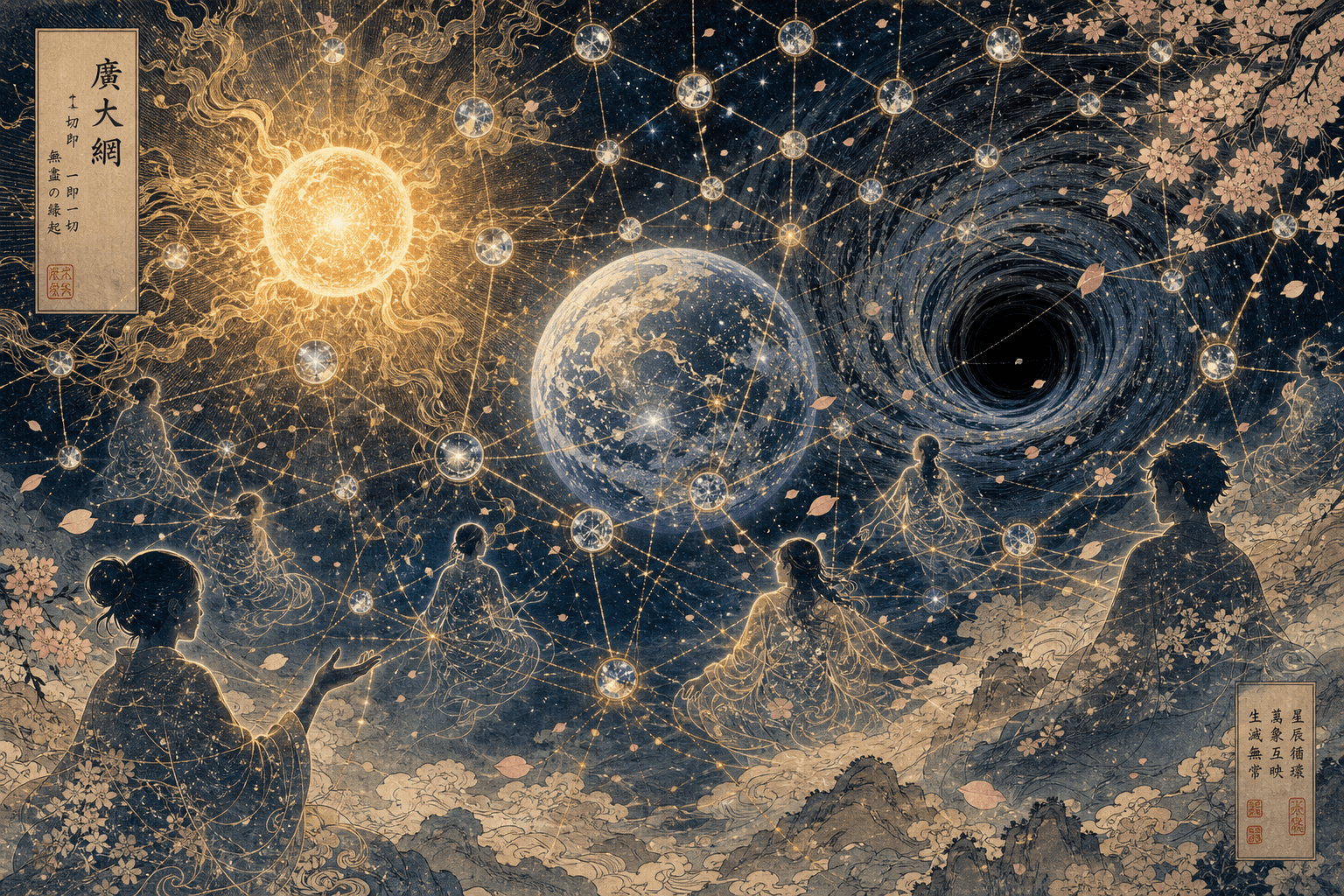
Imagine an infinite net stretching in every direction. No center. No edge. No beginning, no end. At every intersection of the threads, where they cross, there is a jewel. An infinite number of jewels in an infinite web. And each jewel reflects every other jewel. Not just the ones nearby. Every single one. And each of those reflections reflects every other jewel. Infinitely, in every direction.
So what do you see when you look at one jewel? You see the reflection of every other jewel. You see the whole net. You see all of it.
This is an image I like to think about, but it's literally true with interdependence. This is, because that is. Everything is connected to everything else.
Think about yourself for a moment. Your body. Most of the genetic material operating inside what you call your body right now is not even human. The number of microbial cells in your body roughly matches the number of human cells. You have bacteria, fungi, organisms you'll never meet, that you cannot even see. The number of microbial genes operating inside you is about 150 times the number of human genes.
That's just what's happening in your gut. And your gut produces about 95% of the body's serotonin, and the bacteria living there play a major role in regulating it. So in a very real way, your mood is partly determined by bacteria in your stomach. It's fascinating.
Where exactly does "you" end and "not you" begin? I don't think you can find the line, because there isn't one. The boundary we assume is there, that clear edge between self and not-self, between inside and outside, turns out to be a conceptual convenience maintained by a mind that finds separation more comfortable than connection.
So in this sense, Indra's Net isn't just a metaphor about invisible connections. It's a description of what's structurally and mechanically true about reality. That one thing is, because of something else.
And going back to the Artemis mission, that's what Jeremy Hansen meant when he said, "We are a mirror reflecting you. This is you." I don't think he was just speaking poetically. He was describing what is structurally the case.
The four astronauts are made of the same elements as the rest of us. They were trained by people who were taught by other people going back generations. They were carried into space by a vehicle built by thousands of engineers. Their food was grown by farmers. Their suits were sewn by garment workers. The very courage they had was made possible by people who loved them and held them together long enough for them to be willing to risk that much.
When you look at the four of them, you really are looking at all of us. Hansen was reading off the structure of reality.
It's the same in the movie. Grace and Rocky weren't connected because they decided to be. They were connected because the dying of two different stars had already woven their species' fates together before either of them was aware of it. And they just lived that connection through, as friendship.
Looking Up
With my thoughts turned to the cosmos for these past weeks, I've been spending a lot of time looking at the night sky. Sometimes at night I'll go sit outside in the hot tub and I'll just look up, because where I live it's really dark and we have a really wonderful view of the stars.
I'll sit there, and I think about what is it that I'm actually seeing? When you look at the night sky, you see light, but not all of it is the same kind of light.
Some of what you see is light being generated. Nuclear fusion happening inside stars millions or billions of light years away. Those stars are genuine sources of radiance. They're converting hydrogen into helium and releasing energy, some of which eventually reaches your eye after traveling these unimaginable distances through space.
But some of what you see is reflected light. Jupiter, on certain nights, is the brightest object in the sky, brighter than almost any star. But Jupiter doesn't generate light. So what you see when you look at Jupiter is the sun's light, bounced off Jupiter's atmosphere, traveling across the solar system to reach your eyes. It's the sun, wearing Jupiter as a mirror.
It's the same with the moon. On a full moon night, it can be bright enough that the landscape is lit up and you can walk without a flashlight. But the moon isn't generating any light. It just happens to be in the right place, and it acts as a reflective surface.
And then you have black holes. We can't really see those out there, at least not with the naked eye. Black holes don't reflect. They don't generate light. They are regions of spacetime where gravity has become so intense that nothing, not even light, can escape. Everything that approaches beyond a certain threshold is drawn in and doesn't come back out. So black holes consume.
Three fundamentally different modes of relating to light in the cosmos. Stars generate light through transformation. Planets and moons reflect whatever light comes to them. And black holes consume light, drawing everything inward.
And as I was sitting there looking up, I realized these aren't just astronomical phenomena. These are human experiences. These are states that every one of us cycles through.
The Crew Was in Star Mode Together
Most of us, most of the time, are in planet mode. We're reflecting the light around us. Our mood mirrors the mood of the room. Our energy responds to the energy we encounter. We pick up the stress of the people we love, and that becomes our stress. We absorb the warmth of a good conversation, and it lifts us.
We're not necessarily generating anything particularly new. We're receiving and passing along. The quality of what we pass along depends largely on how clear we are. How clean the jewel is.
Going back to the jewel analogy in Indra's Net, the jewel reflects the light of every other jewel. But if the jewel is covered in dust or covered in clay, that affects what gets reflected back.
But then sometimes something shifts in us, whether it's through practice or personality or just causes and conditions. Sometimes we can be more like a star. Let's call this star mode. Now you're not just reflecting. You're transforming what you've received into something. You're generating light.
I think we all know people like this, people who feel like they're in star mode. Teachers you've encountered. Best friends you might have. People who just leave you feeling more alive than when you arrived. They're doing something with what they've received, and that output is genuinely warm. It's like light.
And then you have the black holes. These, again, are moments that many of us at some point will feel. When we're in black hole mode, the ordinary dynamics of exchange break down. Instead of reflecting, or transforming, or creating, the energy just goes in and it doesn't come out. These are states where it feels very difficult, if not impossible, to be present for anyone, because you can barely be present for yourself.
I think of things like grief, at certain intensities, that might feel like this. Trauma responses. The three poisons, especially craving and aversion, can create something that feels like a gravitational collapse. The consuming overwhelms any ability to reflect or to create light.
I want to be clear that this doesn't mean that the person is bad. It means the conditions of their inner world have reached a critical density.
So I keep thinking about why the Artemis mission was such a profound experience for myself and for many of us. Again, most of us, most of the time, are in planet mode. Some of us, more often than we want to admit, are in something close to black hole mode. The cultural backdrop has been so saturated for quite a long time now with the latter, that we kind of forgot what the alternative even looks like.
And then we watched four people in star mode. The crew. Not heroes. Not superhumans. Just four highly capable, competent people, channeling what they had received from their training, from the experience they were having, from each other, from the people on the ground, from everyone who had ever helped them get there, into something generative.
They were good at something, and more importantly, they were good to each other while doing it. It was like seeing these four humans in star mode just creating light together. It was a beautiful thing to watch. Star mode together.
And that's what I enjoyed about watching Project Hail Mary. The characters Grace and Rocky, that's what they did. Theirs was the smallest crew. Two beings who couldn't even share an atmosphere, sharing a project, and making it work together. Star mode, on the scale of two people.
And then in the interview later, when Christina said the word "crew," that's what she was describing. All of us here on Earth. She wasn't talking about a job title. She was describing what star mode looks like when more than one person is doing it at the same time, in the same direction, for the same reason. I really like that.
And here's one more thing. Even when we are in star mode, you're still in the net. Even stars don't generate their own light from nothing. They're converting hydrogen left over from older stars that exploded and seeded the universe with the elements that built them. Even the most radiant object in the cosmos is still receiving and transforming. It has causes and conditions.
The Artemis crew did not create themselves. The characters in the movie didn't create their own capacity to love or to generate friendship. It was the conditions that came to be that delivered them to the moment. They responded skillfully to what arrived.
It's like I always say: life gives us Tetris pieces. It's what we do with those pieces. That's what star mode is. It's not self-sufficiency. It's a particular kind of relationship you develop with whatever it is that you've been given. In this case, all the elements are there for the star to be able to produce light.
States, Not Identities
I want to emphasize here that when I'm talking about stars, black holes, and planets, these are states, not identities. It's not that this person is a star and this person is a black hole. We're all of these things, and we all go through the various states. I think they shift and change and rotate through time.
I know I've spent time in every one of those states. Producing light that helps others. Being a simple reflection that gives off the light of what I've received from someone else, or that's coming from somewhere else. And I've certainly been, at times, the black hole. The state where I can't put anything out, not even a reflection. I'm just taking it all in and absorbing it.
The mind loves to assign permanence. The mind wants to label. "Oh, she's a star. He's a black hole. Me, I'm just a reflective planet." And that feels like understanding, because the mind likes to file things and then call it done. "Okay, I know you. You're this, or you're that."
But that's not what we should do here with these understandings of stars, planets, and black holes. Permanent categorization is exactly what interdependence pushes back against.
Going back to Reid Wiseman, the crew member whose wife had died in 2020. When his wife had passed away, he was almost certainly not in star mode. He was probably going through a difficult black hole mode. The conditions of his life had collapsed. He had two young daughters who had just lost their mother. He had a career that required him to stay operationally excellent while he was going through what was probably one of the worst chapters of his life. Those are causes and conditions.
Whatever he was doing internally during that time, it was probably not generative warmth or light. Maybe it was just survival mode. Maybe it was simple reflection. I don't know. But the point is conditions change. And for him, conditions had changed because of what he was going through. And conditions always change. We know that. They always do.
And then six years later, he was floating in a spacecraft more than 200,000 miles away from Earth, putting his arm around the man whose voice was naming a crater on the moon for his wife. The same man. Two different conditions. Two different places in space and time. And at that point, in that embrace, it looked like a star giving off light.
I just love to think of that. That we're going to go through and transition through these various stages in life.
In the movie, it's the same. In our own individual lives, it's the same. Something I love about the movie is that the character at the beginning had no one on Earth he was willing to die for. He would not have turned that ship around. He didn't have the capacity to do that yet. But the man at the end of that story, the same man with different conditions at that point, had the capacity. He didn't bring it with him. It was developed there.
And even the most consuming object in the universe, the black hole, isn't permanent. Stephen Hawking proposed what's now called Hawking radiation. Over almost unimaginable timescales, black holes emit particles at their event horizon. They lose mass. And eventually, theoretically, they evaporate entirely. So the most collapsed object in the known universe still eventually gives something back. That's a fascinating thought.
So when you encounter someone, or you notice you yourself are in that black hole mode, what that tells you is that the conditions of that person's life have reached a state of gravitational collapse. It's a description of conditions. It's not a verdict on who they are. It's not a label, because conditions can change. They sometimes do. Eventually they will. That's just the nature of reality.
So when you do find yourself in one of these states, which you will, which we all will at some point, the same thing is true of you. It's the recognition that this too shall pass. But the work is to be skillful with whatever state you're in. If I know I'm kind of in a black hole moment right now in life, I can navigate that skillfully, because I know I'm in the black hole state. I want to be careful not to consume your energy and devour it. I want to be skillful in my relationship with you because I know that I'm in a black hole state, for example.
The state is not the self.
In Buddhism, we have a word for the teaching of emptiness. It's sunyata, and it's translated as emptiness. It's the observation that nothing has a fixed, independent, self-contained existence. You don't exist the way you think you do. You're more like a process than you are a thing. You're more like a verb than you are a noun.
And Pema Chödrön put it like this, which I've always liked. She says, "You are the sky. Everything else, it's just the weather." The sky doesn't fight the storm. The sky makes room for the storm to exist, and to move, and to grow, and to intensify, and ultimately, to dissipate. The sky is not threatened by the weather, because the sky is not the weather.
I think there's something in you that can observe your own states. That can notice when you're in planet mode, when you're in star mode, when you're in black hole mode. And that noticing, that awareness, the awareness itself, is not one of those states. It's the sky watching the weather.
A planet can't just decide to become a star. A black hole can't just choose to radiate light. But a human being, in the grip of even the most difficult or contracted or consuming state that you might find yourself in, does have the ability to observe. And through that observation, perhaps to pause, and perhaps to notice and name what's happening. And that moment of noticing is the beginning of something. It's where the polishing of the jewel actually starts. Each jewel in Indra's Net.
The Quality of the Light
So the Artemis crew named a feature on the moon for a woman who couldn't be there to see it herself. They did that on a mission that was already historic, in a moment they could have spent on anything else. But they chose to spend it on each other. And I love that.
And in the film, Grace turned a ship around. He gave up coming home for one specific being who couldn't survive in his atmosphere and whose language he didn't even speak.
Two stories. One real, one fiction. But both about love and friendship across distance and in spite of differences. Both about people who chose. And that is what humans can do for each other across distance and time. That is what Indra's Net does when it's working. It reflects. Every jewel reflects the light of every other jewel.
And you are in this net. You can't opt out of it. Every moment, you are reflecting, or transforming, or drawing inward. And all of it enters a system whose full effects you'll never see. You won't see most of your impact. The ripples that you send into this web are beyond your ability to trace. A moment of genuine presence in someone's life becomes a condition in their life that shapes something you might never even know about. You'll never know what it shaped or how it shaped it.
You're a planet. You're occasionally a star. You're occasionally a black hole. And that's also true about everyone you know. Everyone you love. Everyone who has ever hurt you. And none of those are permanent.
The work of practice isn't to become one over another. It isn't to become a star and stay there. That would be its own form of grasping, and even stars eventually go supernova. So the work is really to keep polishing the jewel in the net. To notice when dust or grime collects and accumulates, and to clean it, to polish it off. To be an effective reflection of everything that's there. To cultivate the conditions that help you move from one state to another. From feeling contracted to feeling open. From consuming to maybe reflecting. And from reflecting, maybe to generating or creating light.
And none of those are permanent. You don't need to be the source. You just need to be clear enough to let the source through.
Two Things to Try This Week
Before I go, two things I would encourage you to try this week.
First, ask yourself from time to time: what mode am I in right now? Am I in planet mode? Star mode? Black hole? And don't do this as a form of judgment. Just do an honest look at your current conditions.
Then, pick one relationship in your life that's confusing or difficult, and ask the same question about the other person. Again, don't do this as a permanent label. Do it as a description of the conditions they seem to be experiencing at this given moment in life. And ask yourself: knowing that this is an impermanent thing with causes and conditions, what does that change about how I show up for this person? If I know they're in the state of being a black hole, or a star, or a planet, how does knowing what's happening change how I show up for them?
And remember, you're always a condition in someone else's weather. The question is, what kind?
That's all I've got for this episode. Thank you for listening.
Until next time.
For more about the Secular Buddhism Podcast and Noah Rasheta's work, visit SecularBuddhism.com. For information on the upcoming retreat at Drala Mountain Center, visit eightfoldpath.com/retreats.