

Skillful Mindfulness
Episode 217 of the Secular Buddhism Podcast
Welcome back to another episode of the Secular Buddhism Podcast. This is a recording of a Dharma talk I gave several weeks ago on the topic of right mindfulness. It's part seven of an eight-part series where I went through each of the aspects of the Eightfold Path. This is part seven, and the next episode will be part eight, just to finish that up. Without further ado, here is a talk on skillful mindfulness.
Setting the Stage
So the last several weeks we've been going through each aspect of the Eightfold Path. We started with the wisdom portion of the path with right view and right intention, then the ethical conduct portion of the path where we explored right speech, right action, and right livelihood. Last week we got into the mental discipline portion of the path where we talked about right effort and talked about being skillful gardeners of our minds: knowing when to build a fence around the garden, when to pull the weeds, when to plant seeds, when to water it, just tending to the garden of the mind.
Today we're going to jump into the topic of what might be the most well-known word of the Eightfold Path, and maybe the most misunderstood too: mindfulness.
The Camera Analogy
An analogy that I like to use that's helpful for me: imagine if you woke up tomorrow morning and realized there's a camera now that's permanently attached to you and you have to use it all the time. Maybe it's attached to your head or something, but you can't take it off. It's always recording. It's always capturing whatever is there in front of you.
Once you realize, okay, I can't take this thing off of me, it's just there and it's always recording, what would you do? How would you learn to use it well? I think you would start to figure out how to control the focus, how to control the zoom. Do I want to be zoomed in or zoomed out? What are the aperture settings? All the things with these nice cameras. I'm picturing a DSLR, one of the nicer cameras (though I guess your phone camera has a lot of these settings now too).
The thing is, we all already have this somewhat, this camera that's fixed to us. We could call it consciousness. We're always aware of something, so we're always capturing something. And the question isn't whether you're aware or not, because there is something in the sphere of your awareness. But maybe the better question is: are we skillfully aware? What are we aware of, and how skillful are we with that awareness?
We tend to jump from thing to thing, zooming in on our worries, getting stuck sometimes on that zoomed-out, wide-angle shot of our anxiety, or maybe we're constantly adjusting focus, trying to hone in on whatever's grabbing our attention. We're taking thousands of mental photos every day, but are we really choosing what we want to capture?
That's where skillful mindfulness comes in. It's kind of like learning to turn off the auto mode on the camera and really manipulate the settings in a way that you can capture things the way you want to.
Mindfulness as Your Driving Awareness System
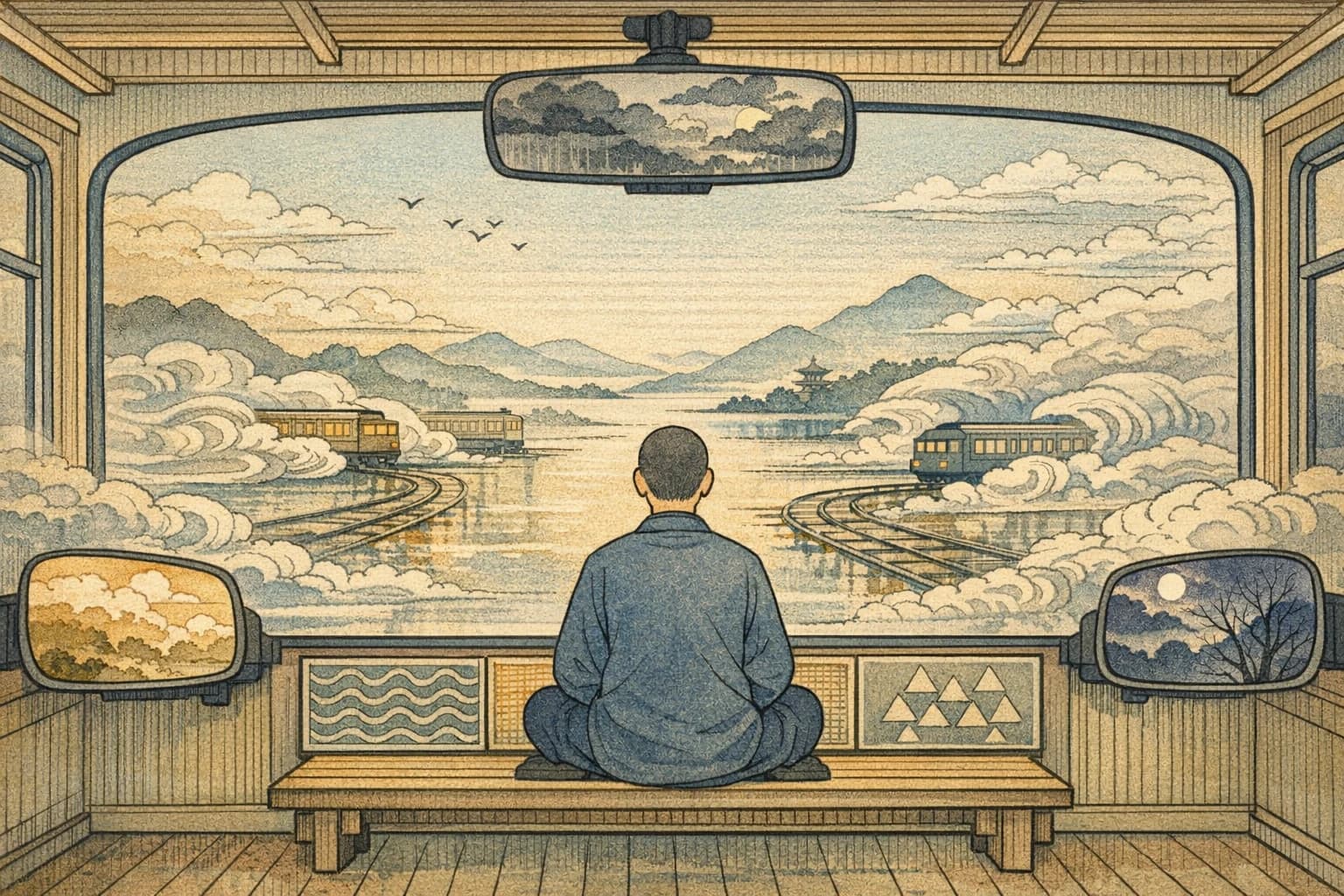
Another way to think of this: if you think of the overall path as a journey of driving, you could think of mindfulness as the complete awareness system when you're driving. The windshield, the mirrors, your peripheral vision, it's just the whole ability of being able to be aware when you drive.
I like to ask myself with mindfulness: if I'm not mindful, how will I know if my view is skillful or not? If you tie this back into the other aspects of the path, without mindfulness, how do I know what my intention is, whether it's skillful or not, my intention when I'm speaking or acting? Or without mindfulness, how can I have skillful effort like we talked about last week? How do I know if it's time to weed the garden or if it's more appropriate to water it right now or to plant new seeds?
Mindfulness is the faculty that allows us to be aware of what's happening while it's happening, without immediate judgment. It's a gentle, non-judgmental state of awareness of the present moment.
The Train Station
Now, another visual analogy that I think is helpful here. Imagine that your mind is a busy train station. You've got trains coming and going. These are like our thoughts and our feelings, the sensations that are constantly arriving and departing, like trains at a busy train station.
To live unmindfully, it's like whatever train pulls in, you're just jumping on and going for a ride without thinking about whether or not that's the train you actually want to be on. Here comes the train of anger. I just hop on, and it might be miles before I realize, "Oops, I don't think I want to be going in this direction on this train." You get carried away by every passing mental event.
But to have skillful mindfulness is more like learning to remain in the train station but sit on the bench and watch the trains. You can see, "Oh, here comes the 10:35 Anger Express," or, "Here comes anxiety," whatever the train is. You can see it, you can acknowledge it, but you don't have to jump on. You don't have to get on the train. You remember that you do somewhat have a choice.
Or if you find yourself suddenly on the train, you might say, "Okay, I'm going to hop off the train and head the other direction," because it's better to realize this having gone one station in the wrong direction rather than fifteen stations.
So the "how" of mindfulness is really this: it's developing the capacity to sit on that bench and just witness the comings and goings of your inner world without being swept away. And it sounds very simple, but it's not easy. It's a skill that has to be cultivated.
Common Misconceptions
There are common misconceptions that I know I've had and that I hear a lot about when talking about mindfulness. Sometimes the misconception is, "I'm supposed to learn to stop the trains. I need to empty the mind." You've probably heard that, right? Or achieve some sort of mental state where you can slow down or pause the trains, the coming and going.
But that's just not how it works. And the problem with thinking that's how it works is that the moment you sit there and start observing, your first thought is going to be, "Well, I'm terrible at this because my mind won't stop." The trains are speeding up, or there are more trains than I ever noticed.
But asking your mind to stop thinking is like asking your heart to stop beating. It's just not going to happen. And if it did, you're gonna have bigger problems than being mindful.
Because the goal isn't to stop the trains of the mind. The goal is to realize that you're in a train station watching the trains, but that doesn't mean you need to hop onto every train that arrives.
I guess what I want to acknowledge here is the trains that come and go, they're not the problem. The thoughts that arise in the mind, the "monkey mind" as it's sometimes called, that's actually not the problem. The problem is when we are so identified with these thoughts that we don't even realize we're being unintentionally driven to destinations we didn't necessarily want to go to because we hopped onto the train and didn't even realize it.
So I want to get this out of the way with the misconceptions: mindfulness as a practice is not about stopping your thoughts. The goal isn't to have a blank mind. It's more about having a clear mind that's capable of noticing whatever is in there.
It's also not about being passive. It doesn't mean, "Okay, I'm gonna sit here and just watch life go by." No, it's about seeing clearly so that you can act more skillfully and say, "That's the train I want to be on. That one over there on platform three, not the one on platform two."
And it's not about being calm all the time. Calmness might be a side effect of being mindful. But the actual gift of mindfulness is clarity and choice, being able to act skillfully. So the goal isn't to just be calm.
What Mindfulness Really Means
Now, in classical Buddhist teachings, the word used for mindfulness in Pali is directly translated to "remember," to "have a recollection." So it's really about remembering to be present. That's what it boils down to. Remembering that you're capable of being aware. You have a choice in how you relate to whatever's happening in the mind, but you don't necessarily have a choice about whatever's happening in the mind.
And in these classical teachings, skillful mindfulness has three qualities.
First, it's aware. That's like recognizing, "Hey, the camera's on. It's filming everything." You're conscious of what's happening in your body, in your mind, your environment around you.
Second, it's accepting. You're not fighting against reality. Just like if you have the camera rolling and it happens to be raining outside, you don't have to curse the clouds to go away. You recognize, "Hey, it's raining." So you make some adjustments on the camera. Maybe the lighting is different now because it's cloudier.
And the third is that it's discerning. This is the skillful part of it. You're not just passively recording everything. You're making choices about where you want to point that camera. What do you want to focus on? How do you want to adjust the lens? Zoom in, zoom out. How do you want to frame it?
The Four Foundations of Mindfulness
I don't know if you recall when you were learning to drive. I was just thinking about this recently when I was going through the renewal portion of the school bus driver training you have to do every year. When they're teaching you to drive, they tell you to focus your attention on different directions. You scan out on the horizon. There's what you see through the windshield. Then you look down and scan your instrument panels. You look out to the sides, check your mirrors, your blind spots, and then you've got the rearview mirror up here, and you look through that to see what's behind you.
I was thinking about how that correlates really well with the teaching of the four foundations of mindfulness. The Buddha laid out four areas where we can develop mindfulness, and I think these map perfectly with this idea of when we're learning to drive and have to hone in on four different things we're paying attention to.
Mindfulness of Mental Objects: The Windshield
Looking forward, looking out the windshield at the road ahead, that's like the teaching of mindfulness of mental objects. This includes thoughts, emotions, mental patterns. You watch how thoughts arise, how they hang out for a bit, and then they pass away. You notice how certain thoughts might trigger certain emotions, and certain emotions might trigger additional thoughts. You're just aware of the landscape that's playing out there in the windshield.
This is like scanning the road, seeing what traffic looks like, noticing what signs are approaching. That sign mentions the speed. This other sign tells me what road I'm on. Just the upcoming conditions.
Looking at this through the inward lens of looking out the windshield, it's like the awareness of what are my patterns, my propensities, what frameworks do I see as repetitive in my mental patterns. You're watching for what's coming in your mind's eye. "Oh, here comes anger. I see the sign for it. It's coming up ahead." Or craving, or restlessness, whatever it is.
Mindfulness of the Body: The Dashboard
Then you have the moment where you look down and scan your instruments. This is like looking at the dashboard. In the teachings of the four foundations, this would be mindfulness of the body. This is getting familiar with the physical sensation of being alive: the sensation of breath going in and out of your lungs, the feeling of your feet on the ground, the sensation of tension in your shoulders, whatever it is.
Most of us live so much in our heads that we forget sometimes about the sensations in our bodies until they're in pain, until they hurt. And we're like, "Oh, that's right. I have a lower back," or wherever you're feeling that pain.
Using this analogy, the dashboard when you're driving tells you useful information: your speed, how much fuel do you have left, are you close to being empty? If you look closely at a lot of these instrument panels, there's a lot of information there that we don't typically glance at. The temperature of the oil or the engine, just information about the vehicle's condition.
Our body kind of does that for us. Your body is giving you information, and when you pay attention to it, you might notice things that you didn't notice when you weren't paying attention. Like, what is my posture like right now? Where do I feel the breath? Do I feel fatigue? Am I experiencing hunger? Is there tension?
A good driver glances at that dashboard from time to time because they would want to know the warning signs before they see smoke coming out of the front of the vehicle. You would ideally have noticed some of those warning signs from the dashboard indicating that something might be off.
Mindfulness of Feelings: The Side Mirrors
Then you have what's called mindfulness of feelings. I like to think of this as looking out the sides and checking your mirrors, looking through those blind spots.
Here, when we're referring to feelings, we're not thinking of specific emotions like anger or joy. This is the feeling of the immediate sense of pleasant, unpleasant, or neutral. The feeling tones. You go to sip your first cup of coffee and something arises. It's either pleasant or unpleasant. You step in a puddle, suddenly "unpleasant" is what gets flagged. Or you look over at the color of the wall, it might be neutral, nothing really screams out there.
These feelings happen automatically in our lived experience. They happen before thought and they happen before emotion. And when we don't notice the feeling tone, it might drive us unconsciously. Things that are pleasant might pull us into the feeling of grasping. Things that are unpleasant might suddenly give rise to aversion. Neutrality might lead to inattention.
Visualizing these mirrors when we're driving helps you have a sense of what's alongside. Is there a vehicle there that I need to be aware of? It might not translate to direct action, but I'm just aware of what's there. Maybe it's just out of sight, but I need to be aware of it in case it's going to drift into me.
Pleasant, unpleasant, and neutral feelings are kind of like these nearby cars. They could suddenly be something you have to be aware of because they're subtly pushing you or pulling you or getting in front and forcing you to change lanes. But for the most part, these feelings are just information. They're signals, not necessarily problems to solve.
Mindfulness of the Mind: The Rearview Mirror
And then we have looking in the rearview mirror, seeing what's behind. This is like awareness of your mental state. It's not the specific thoughts, but maybe you're just aware of the overall weather of your mind. Is it cloudy out there? Is there some confusion? Is it stormy?
Again, you're not trying to change these conditions. You're not trying to change the weather. You're just trying to notice it and see what it is. With the rearview, it shows you where you've been. And you don't want to stare at it, right? You don't stare at the rearview mirror, but you just want to be aware of what's following you.
Mindfulness of the mind is like noting the weather patterns. What's trailing you? Is that storm coming towards me or is it moving away? That's how I like to think of it.
The Paradox of Mindful Effort
So moving into the paradoxical part of this whole teaching with skillful mindfulness, and where it connects to skillful effort that we talked about last week: mindfulness requires a really particular kind of effort because you want to be alert but somewhat relaxed. You need to be attentive but also not tense.
It's kind of like if you were holding a bird in your hand. You need to grip it tight enough that it's not going to fly away, but not too tight to where you're hurting it either. That's kind of how it works with mindfulness as a form of attention. It's learning to hold your attention in a way that can be sustainable but is also gentle.
Common Traps
Okay, so some of the common traps that I think are worth discussing when we're talking about mindfulness.
The Trap of Perfection. "I need to be mindful all the time" or "be perfect at being mindful." No, you don't. That's exhausting. It's impossible. Even experienced meditators aren't mindful 24/7. Think of it more as, "I'm just trying to increase the moments of mindfulness." From whatever the baseline is in my day-to-day experience, I'm just trying to be a little bit better at it. It's not a permanent state of awareness.
The Trap of Positivity. Sometimes when you encounter mindfulness as a practice, the mistake is thinking, "Okay, I need to use mindfulness as a way of avoiding difficult emotions." It might be easy to think, "I'm going to observe my anger until it goes away or until I feel positive again." But that's not how it works. Sometimes the skillful response is to sit with the anger, fully feel it, let it move through you, and not just hold it off at bay in the distance.
The Trap of Self-Improvement. This one is common too, where we turn mindfulness into just another thing to optimize, another thing we need to be more efficient at. Then we start thinking, "Well, I need to be mindful so that I can be better at working," or whatever the thing is. This one's tricky because yes, mindfulness can help you be better at things, but if that's the reason you're doing it, or the only reason you're doing it, then you're missing the point. Because it's more about being fully alive, not just being more productive.
The Trap of Self-Judgment. We start to be mindful and then we think, "Oh, I'm being mindful of how terrible I am at being mindful." We have this ability to take something like awareness and just turn it into a weapon against ourselves. So remember, mindfulness includes kindness. You're not the judge. You're the observer. You're just watching.
Practical Applications
So how do we actually apply this in our practical day-to-day lives?
I think you could pick a few transitions in your day, whether that's transitioning from work to home, or when you get in your car and start it, or when you're sitting at the red light in traffic. You could use these little moments as mindfulness reminders, or mindfulness bells, where for a moment you just think, "I want to be aware. Where am I? What's happening in my body? What is the quality of the feeling in my mind right now?" Just increase that sense of awareness.
Another way to practice this is to pick one specific task where you say, "Okay, I want to choose one activity, whether that's brushing my teeth, washing the dishes, or folding the laundry, whatever it is. For that moment of doing that, I want to do it with full attention." Notice when your mind wanders, because it will, and just bring the mind back into that place of paying attention. You're not trying to have a full-blown spiritual experience washing the dishes. No, you're just trying to wash the dishes with greater awareness.
Or we've talked about the pause, where you could try to increase the amount of time in that gap between stimulus and response. That's another way you can practice it.
The Zoom Feature
I mentioned at the beginning with the camera, I've always liked the analogy of the zoom. Because the zoom feature when it comes to mindfulness as a practice is recognizing that we have the ability to zoom in or zoom out. We often get stuck at one specific setting and forget that we can change it.
If I'm dealing with pain, for example, physical pain, instead of zooming out there, I actually might want to zoom in and get really specific. Where am I feeling this pain? Is it my back that hurts or is it just my lower back? Is it the front of the lower back or the back of the back? You try to get more zoomed in and really understand what it is that you're feeling.
Then if it's a different type of feeling, let's say anxiety as an example, there you might not want to be zoomed out, because being zoomed out and having that bigger picture and imagining what's coming down the road, that's part of the problem with anxiety. There, you might want to say, "Okay, let me focus on zooming in for a moment to what I'm feeling in the present moment."
Or for some people, this might be backwards, where you're stuck in the intensity of that moment. Well, then maybe zoom out and say, "What is the bigger picture here? This is what I'm feeling now, but what will I be feeling tomorrow?"
There's not a right setting that works for everyone.
Why Mindfulness Matters
The reason all of this matters, why mindfulness on the Eightfold Path matters so much, is because we all know we live in a world that is actively fighting for our attention. It's the most valuable currency we have: our attention. Every app you use, every ad you encounter online or driving, the billboards, everything is designed to grab your attention and have it pointed where someone else wants you to have it, not where you want to have it.
But with skillful mindfulness, we realize we have a choice. We probably can't control what shows up in the windshield or in the lens of the camera. But we can choose how we focus at this moment with what we have to work with. This is what I'm seeing. This is where I am. Now what am I going to do with that?
I think mindfulness on the Eightfold Path is really about being here for this experience, this present moment. I often think, how many moments in my life have I missed because I was just lost in thought? Not that that's a bad thing, but how many conversations have I been in where I was mentally somewhere else and maybe didn't have the ability to connect in the way that I could have, had I been a little bit more mindful of what was actually taking place? How much of my life have I experienced just through the fog of distraction, maybe without noticing?
Mindfulness kind of comes in as an antidote to living life on autopilot. It's the difference between daydreaming or sleepwalking through life rather than being fully awake for the life that you're experiencing.
The Invitation
Mindfulness is always there. It's always available. You don't need anything special. You just need to practice the skill. And right now, anyone can do it. You can do it in this very moment by just becoming more aware of what you're experiencing: whether that's focusing on your breath, or paying attention to what it feels like to be sitting in the chair you're sitting in, or the feeling of your feet on the ground. There are a lot of ways, and they seem small and insignificant, but they're not.
Every moment of mindfulness can ultimately become a moment of liberation and freedom because it's a moment where you're not completely identified with your thoughts. You're not totally lost in your story, and you don't have to feel totally reactive to life as it's unfolding. And if you can do that even for a moment, those moments start to add up and start to create space. Space where you learn to respond skillfully rather than react, and space to actually experience your life instead of just thinking about it.
So my invitation to you for the week is to maybe pick one activity where you make this your mindfulness practice for the week. It could be brushing your teeth, washing your dishes. It could be the evening walk you're gonna go on. But pick one activity where you try to be more aware and notice the sensations that are taking place, whether in your body or in your mind.
Another way you can practice this: you've probably heard of the 5-4-3-2-1 practice. You could pick one time of the day where you try this, where you notice five things you can see with your eyes, four things you can hear, three things you can feel, two things you can smell, and one thing you can taste. You could do all of that in about 30 seconds, but it's a quick way to bring your awareness into the present moment.
And just remember, the goal isn't to be mindful all the time. That's not it. It's to be mindful some of the time, where you have real purpose behind it. And as I've mentioned before, with this practice, repetition matters more than duration. If you're thinking, "I want to be mindful for six hours today," that might not be the skillful way to approach this. But if I could be mindful for 30 seconds ten times today, that's much more effective. Because even short moments, if they're repeated often, can start to rewire how we experience life. And ultimately, how we pay attention to things determines what our life and the experience of being alive is going to feel like from the inside. That might be one of the most important skills we can develop.
Closing
So to close this off, mindfulness is about being awake for your life, whatever that life contains. It's about having more say in how you relate to the experience that's unfolding. And really, that's it. That's what I wanted to share with skillful mindfulness.
For more about the Secular Buddhism podcast and Noah Rasheta's work, visit SecularBuddhism.com